Wednesday, September 23, 2015

Successful Mosaic

Spiky Eruption

Two cold fronts passed in succession leaving a clear sky on September 14th. Observing conditions were wonderful. Temperature ranged between 68 and 71 degrees, and a slight breeze puffed from time to time. It had been cloudy and hot nearly every day for the previous three weeks, and the Sun had been almost entirely blank. So it was nice to finally have some modest solar activity on a comfortable clear day. This Modis satellite image shows how cloud free it was over the eastern U.S. coast on September 14th. My location is marked with an arrow.
The cloudless sky gave me time to capture the entire Sun in the following 38-panel mosaic using a 5X Barlow lens. The image presented below is only one quarter the size of the original 6826 by 6284 pixel image! Four sunspots are visible in the southern hemisphere. From left to right they are numbered: 2418, 2415, 2412, and 2414. Some nice prominences adorn the eastern and western limbs. This is the most successful mosaic I've made so far with my ZWO ASI174MM camera. (Click on the images for larger views.)
The next 4-panel mosaic shows a closer view of sunspots 2418 and 2415.
Sunspots 2412 and 2414 were near prominences on the Sun's western limb.
While capturing videos for the whole disc mosaic I was lucky to see a temporary spiky eruption from the vicinity of sunspot 2418. The eruption didn't last long, probably less than 20 minutes.
Finally, I tried making an image from a 2000-frame video instead of my usual 400-frame video. The following picture of sunspot 2415 was made by stacking the best 100 frames from a 2000-frame video.
The previous image contains probably the best detail I'll ever get with my particular combination of telescope, camera, and viewing location.

Tuesday, September 15, 2015

First Day of School

Kindergarten and Preschool

My granddaughters, Sophie and Annabelle, passed a major milestone last week. Sophie started kindergarten, and Annabelle started preschool. Sophie took great care preparing her backpack for the big day.
Annabelle got some breakfast in her special chair.
Then it was time for pictures. Three cameras were furiously clicking!
Grandparents took their turn in the photo limelight.
It was time to walk to the bus stop. Sophie's entourage included her Mom, sister, and three grandparents.
Sophie met a new friend at the bus stop, a kindergarten classmate. Soon they were looking for bugs together.
When the bus arrived, Sophie set off cheerfully on her new adventure.
Later, Annabelle was warmly greeted by her teacher at her special preschool.
Annabelle gets along with everybody. Soon she was happily installed in her special chair and busy with her classmates.
My earliest memories begin in kindergarten - memories of mistakes, disasters, and misunderstandings. I hope Sophie and Annabelle, instead, will have happy memories of friendships and success.

Monday, September 7, 2015

Exploring With My Granddaughter

Nature Hike

My granddaughter has discovered the joy of walking through the woods!

I was recently invited to accompany Sophie and her Mom on a little hike in neighboring forests. Just before the hike began I saw a red-shouldered hawk on a residential lawn.
Unfortunately, I brought no telephoto lens. When I approached for a closer shot, the hawk flew away and perched itself, majestically, on a rooftop.
Much to our dismayed amusement Sophie insisted on preparing a fully loaded backpack. She enjoyed stuffing her pack with essentials like crayons, markers, notepads, dolls, and snacks. She wore boots in case we wanted to walk through any water. Here Sophie and her Mom begin our adventure on the bike path ahead.
Soon Sophie wandered off the path anxious to show me where she had explored on an earlier trip.
What's more fun when you're a kid than walking through a stream? Sophie walked through overhanging vegetation where I declined to follow.
Next, it was time for a snack on the bank beside the stream.
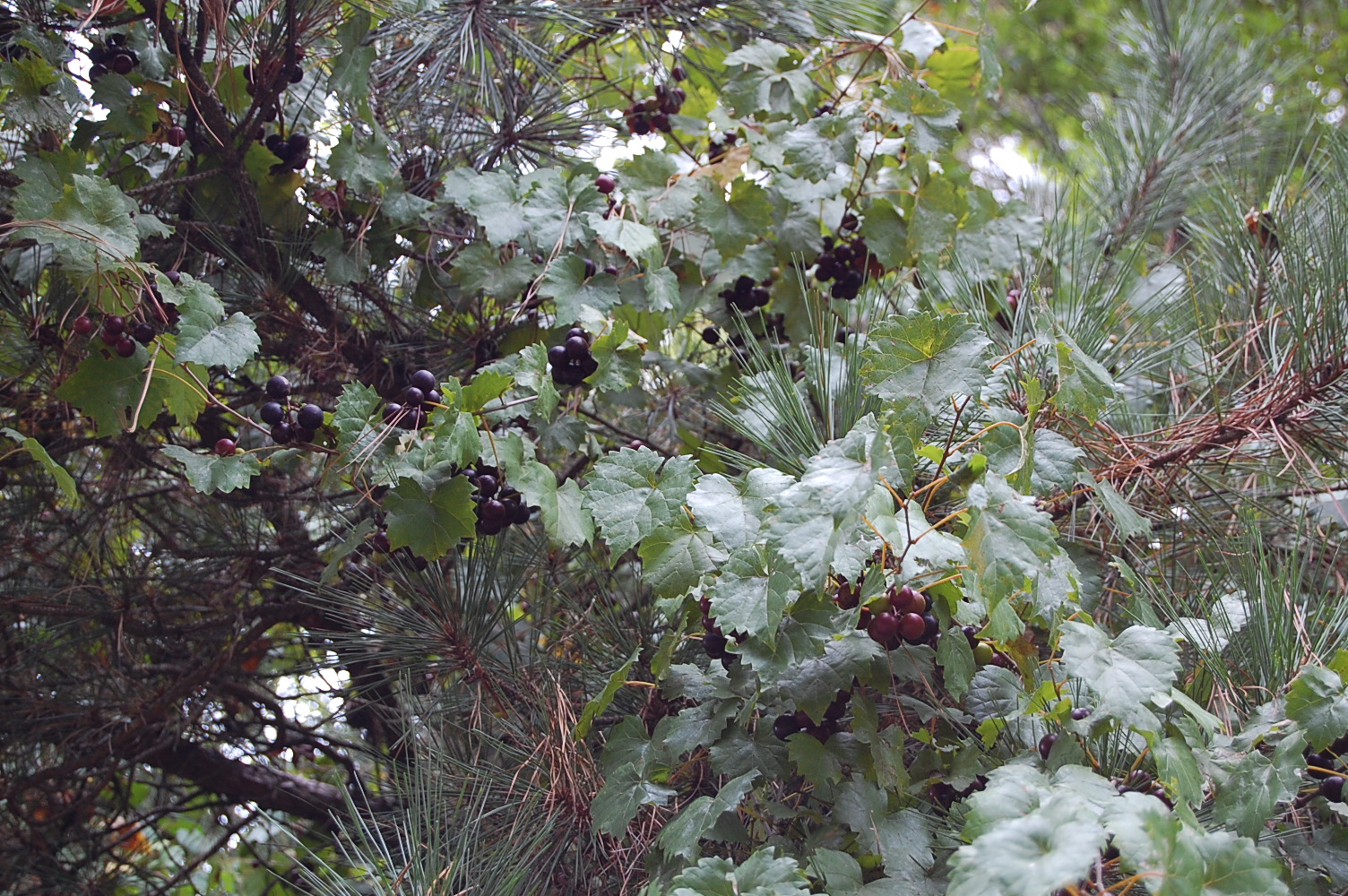
Upon resuming our walk we encountered an amazing number of wild grape vines. As you might expect, most of the low hanging fruit had been removed, but the vines were heavy with grapes higher up. The ripe wild grapes tasted like Concord grapes.
Sophie said, "This tree looks like a fork!"
Along the shaded trail we encountered a pair of dueling butterflies. Two swallowtails seemed to be battling each other as they circled up and around us.
We next spotted an odd furry creature huddled against a tree trunk. The red glow in its eye from the camera flash made it look like a small demon from hell. We think it must be someone's pet rabbit that somehow escaped into the woods.
Soon it was time for the hike to end. Ellen and Sophie walked off to their home not far away.
It has always been my hope to encourage Sophie's curious observation of the natural world. I wanted to collect specimens along the way for her to view later through a microscope. On this trip I came upon only one, a dead green beetle which I scooped up for later examination.
A few days later I persuaded Sophie to examine the beetle through my microscope. It might be an impossible task, but I'll gently urge her to patiently examine things in detail. I've seen too many people look through an eyepiece for 3 seconds and think they've seen everything. Slow, careful observation shows the depth of nature's beauty and reveals features not noticed at first glance.
But Sophie's attention span is limited at this point. After looking at the beetle's hairy, spiky legs, Sophie pronounced them "gross and creepy". She was then eager to run off and play with something else. I hope we do more exploring in the future.

Sunday, August 30, 2015

Conflicting Forecasts

Contradictory Predictions 

Meteorologists often fail to correctly forecast cloud cover. On August 25th one weather forecasting service predicted cloudy skies all day. Another forecasting service predicted completely clear skies and good seeing for a few hours after noon. The forecasts were contradictory! What actually happened?

The sky was almost completely clear around noon, giving me confidence in the reliability of the clear sky forecast. This temporary absence of clouds was the first opportunity in weeks to use my telescope. A few days before August 25th a relatively small sunspot evolved into a giant active complex feature. For days I watched it grow as it moved east to west across the Sun's face. Sunspot activity has been sparse lately, so this unusual episode of clear sky was an opportunity I didn't want to miss. If I didn't catch the sunspot this day, it would rotate out of sight before the next clear day. So I hustled and hauled my equipment outside. It takes about 45 minutes to set up the telescope, acquire the Sun, tune the solar filter, and get the computer and camera ready for imaging. During the setup time I'm usually looking at the equipment and not the sky. Consequently, I was shocked to discover thin clouds drifting across the first images on the computer screen. When I looked around the sky I saw massive cloud banks moving in from the north and west! The clouds had almost covered the sky in the 45 minutes it took to get my equipment ready!

I hurried to capture a few videos through cloud gaps before the situation became hopeless. Fortunately, a few images were relatively unaffected by clouds. The first picture below shows the large sunspot 2403 I had hoped to capture. (Click on the images for a larger view.) Some bright white energetic emissions appear in the space between the giant double umbra on the right and the four smaller trailing umbras on the left. There is good detail in the image, particularly the different shades of darkness in the four trailing umbras. This image was made with a 5X Barlow lens by stacking the 100 best frames from a 1000-frame video.
A few minutes before the previous image was captured the sunspot looked like the next picture made by stacking the best 40 frames from a 400-frame video.
This second image was processed differently than the first image. I think some details are slightly sharper in the second image, and there are subtle differences between the second image and the first.

What a shame the clouds halted my session after less than an hour! The Sun had several nice filaments and prominences in addition to the large sunspot. I started capturing images for a whole disc mosaic, but had to stop after only nine panels were recorded. The next image is a 9-panel imperfect mosaic showing the immediate area around sunspot 2403. The Sun was in and out of clouds during the entire acquisition time.
To the left of center is a region of sharp spicules. On the extreme right center edge you can see the bottom of a huge hanging prominence lifting straight out from the solar limb. Too bad I didn't capture more of this hanging feature. (Click on the image to see these features more clearly.)

Saturday, August 22, 2015

Heavy Dew

Milky Way Photo Attempt

It was very clear on August 15th, two nights after the Perseid Meteor Shower, with no Moon and mild temperature. A high pressure system lingered over eastern Virginia. This was a perfect summer night to try some constellation photography. I walked a half mile to a nearby field away from glaring lights. Mild conditions made it easy to patiently set up my equipment and carefully focus the camera lens. I was just about ready to begin a series of exposures when I discovered fog on the lens. Since I had no dew cap or heater, I had to give up. This was so frustrating! I should have known this would happen and been properly equipped.

Dew was particularly heavy this night. By morning the grass and plants were dripping with moisture. Fortunately, I managed to salvage one 2-minute exposure made as dew just started fogging the lens. Subsequent images were much worse and useless. This image is drastically cropped to eliminate light pollution near the horizon.
Sagittarius, the "Teapot", is on the very bottom just left of center. The Milky Way shows up well, but stars seem a bit blurry instead of being sharp points.

The evening was not a total loss. I saw a spectacular bright meteor pass directly overhead leaving a bright orange trail. This was probably a remnant of the Perseid Meteor Shower.

Next time, I'll arrive with dew fighting equipment.

Friday, August 14, 2015

Battling Clouds

Losing Battle

The first major sunspot in weeks was well placed for viewing on August 9th. Unfortunately, the sky was filled with fair weather clouds. It seemed that observing might be possible through gaps between clouds, so I took a chance and set up my equipment. I managed to capture only six video clips before a huge cloud covered the Sun. This cloud refused to move. Soon the number of clouds increased. At that point I realized the battle was lost and it was time to pack up the equipment.

I had only ten minutes of cloud-free viewing time, but it was enough to capture large sunspot 2396. The following image, made with a 5X Barlow lens, has been processed to show different shades of darkness within the biggest sunspot umbra. A number of small umbras and complex structures are seen to the left of the major umbra. (Click on the images for a larger view.)
The next image is a cropped 3-panel mosaic of a slightly wider region surrounding the big sunspot. This picture has been processed to darken the smaller umbras.
The temperature increased from 86 to 88 degrees while I battled clouds. So much sweat poured down onto note papers that I needed a towel to dry off! Heat exhausts me. I'm looking forward to cooler days.  

Thursday, August 6, 2015

Summer Sun

Sweating

July was not a good month for solar observing. Almost every day was cloudy, and for weeks hardly any dramatic activity appeared on the Sun. Clouds finally disappeared on the morning of July 31st. Although the Sun had few features, I set up my equipment in the heat and humidity.

The following 16-panel mosaic, made with a 5X Barlow lens, shows the Sun's eastern hemisphere. Only one modest sunspot, 2394, is easily visible. A few filaments and active areas are scattered around. Some nice prominences appear on the limb. (Click on the images for a larger view.)
The Sun's western limb was less interesting as seen in the next 6-panel mosaic. Only two active areas are present and no dramatic prominences.
On days when dramatic sunspots are absent the Sun's swirling chromosphere can still deliver fascinating views. The next mosaic image from near center on the solar disc shows a single filament surrounded by grass-like spicules.
I endured only 40 minutes under the powerful Sun this day. The temperature had risen to 85 degrees. The humidity was 87 percent and there was no breeze. Sweat poured down my arms onto my note paper. It's hard to concentrate or enjoy observing in these conditions.  

People say I'm crazy doing what I'm doing
Well they give me all kinds of warnings to save me from ruin
When I say that I'm o.k. well they look at me kind of strange
Surely you're not happy now you no longer play the game

People say I'm lazy dreaming my life away
Well they give me all kinds of advice designed to enlighten me
When I tell them that I'm doing fine watching shadows on the wall
Don't you miss the big time boy you're no longer on the ball

I'm just sitting here watching the wheels go round and round
I really love to watch them roll
No longer riding on the merry-go-round
I just had to let it go

John Lennon