Wednesday, September 28, 2016

Iberian Discovery - Part 1

Exploring Lisbon - Day One

Our recent tour of Portugal and Spain was truly wonderful! Although neither country previously held special interest for me, I'm glad we decided to sign up for a tour. We learned so much, and saw many beautiful things while traveling through countries rich in history. Our witty, erudite guide shared his knowledge and entertained us along the way. The food and weather were outstanding. I'm so glad we took this trip!

Our tour began in Lisbon, Portugal. After checking in to our conveniently located hotel, we set off walking on our own to explore nearby parts of the city. Here's the scene on the Avenida da Liberdade at the beginning of our hike just outside the front door of the hotel. (Click on any picture for a bigger view.)
We soon passed through two attractive, sunlit squares. The first was Praca dos Restauradores, and the second was Praca Dom Pedro IV, or Rossio Square.
Along the way we passed uncountable sidewalk restaurants like these.
The linear density of restaurants per foot along our route was astounding! It seemed every other doorway was a restaurant, many with waiters urging passersby to stop.

Before long we arrived at a pedestrian street, Rua Augusta, lined on either side with shops. Down the center ran an almost unending line of shaded outdoor tables leading towards an enticing monumental arch at the far end.
Heading toward the arch, we strolled past shops like these.
Eventually, we passed under the arch leading to the Tagus River.
The arch opened to a large open square, Praca Comercio, whose immensity was difficult to capture in one photo. The view looking away from the river is shown in the first picture below. In the opposite direction was the Tagus River itself seen in the second picture.
On the green hilltop above and beyond Comercio Square in the next picture is Castelo de Sao Jorge, or Saint George's Castle, our planned destination for the afternoon.
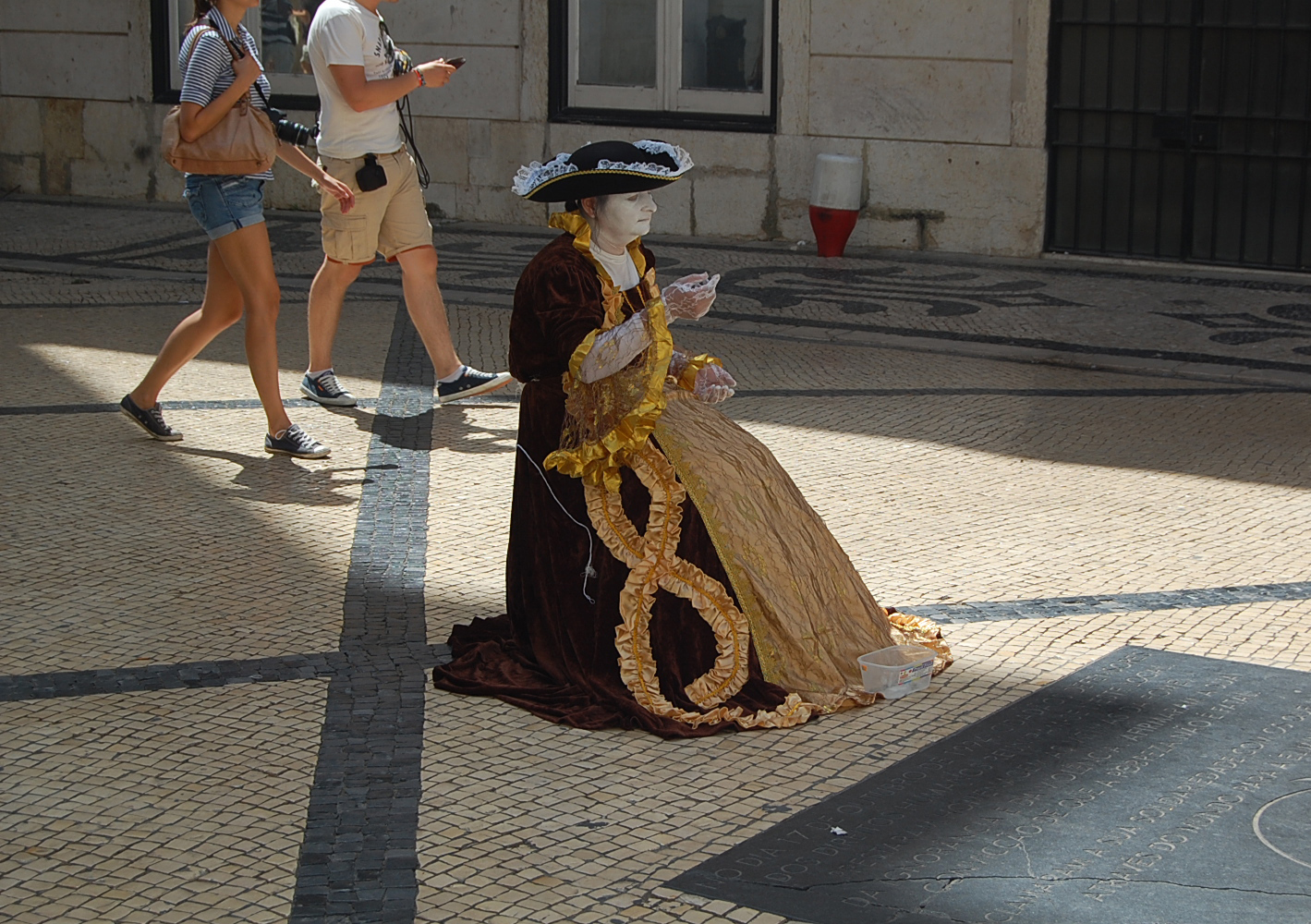
You may have noticed beautiful black and white stone pavement mosaics in many of the pictures above. These mosaics, ubiquitous in Lisbon, were characteristic of many streets, plazas, and sidewalks everywhere we went in Portugal. We learned individual mosaic stones were all installed by hand. Look at the sidewalk in the next picture, and the pavement beneath the motionless street performer in the second picture below.
A street vendor sold beautifully made examples of the mosaic patterns nearby.
The way to Castelo de Sao Jorge passed along steep twisty roads of the Alfama district. Before the trip I was anxious about getting lost in the labyrinth of narrow streets leading to the castle. Navigation turned out to be easier than expected. A few well-placed signs guided us. Heading uphill eventually brought us to the castle on top. We followed trolley tracks much of the way.
Restaurants continued appearing with incredible frequency as we climbed, although now they seemed smaller, neighborhood places rather than tourist traps. We also passed many examples of beautiful tile work.
After winding through more uphill twists and turns on streets like the one in the next picture, we finally arrived at the castle.
The castle hilltop has a long history. First fortified by Romans in about 48 BCE, it was more strongly fortified in the 10th century by Muslim Berbers. The "Moors" were defeated in 1147, and, for many years after, Portuguese kings resided in the castle. When Vasco da Gama returned from discovering the route to India in 1499, he was received by King Manuel I at Castelo de Sao Jorge.

We spent time exploring the castle grounds.
The plaza in front of the castle offered beautiful views of the city below.
Leaving the castle, we headed downhill again, and, after a few errant turns, returned, a bit weary, to our blue-sided hotel shown in the next picture.
It was an exhilarating afternoon. We felt good about ignoring jet lag and seeing so much independently during our first day. The next day we would explore more of Lisbon with the tour group and our guide.     

Sunday, July 24, 2016

July Heat

Dripping Sweat

July and August bring heat and humidity to Williamsburg. Tropical conditions were discouraging on July 21st. Nevertheless, a clear morning sky tempted me to image some sunspots. After a dawn bike ride I hurried to set up the solar telescope as temperature rose into the lower 80's. By the time I started capturing images my shirt was drenched and sweat dripped from my head. Humid air was completely still. I needed a towel to keep from soaking my laptop and note papers.

As I've mentioned before, the Sun has been nearly featureless lately. When a couple of rare significant sunspots were present on July 21st I was motivated to observe them before they rotated out of view. The first image below is a 26-panel mosaic of the Sun's western side showing sunspot 2565 closest to the western limb with sunspot 2567 following further from the rim. A few small prominences sit on the limb. Unfortunately, subtle vertical bands are visible. For some reason flat fielding failed to remove the bands this time. Seeing was good, so features are sharp. (Click on the images for a larger view.) 
The next image is a close detailed view of the sunspot pair.
Most of the Sun was blank, as you can see from the first mosaic image above. On the eastern limb one dark filament floated near a prominence shown in the final image below.
Clear sky lasted just 33 minutes! As temperature rose toward 90 degrees clouds suddenly filled the sky. I struggled to capture a flat field frame between cloud gaps while suffering in the exhausting heat. Once all my equipment was moved inside I collapsed into a chair for a late breakfast. Later that afternoon we cooled off a bit on water slides at Water Country.

Sunday, July 3, 2016

Sunspot Drought

Filaments

When unexpected clear skies appeared early in the morning on June 30th I hurried to set up my solar telescope. It had been six weeks since I last imaged the Sun. With no wind, and temperature near 80 degrees, conditions were relatively pleasant. Good observing conditions are fleeting, however. By the time I was ready to record the first image thin clouds were spreading across the sky. During the next hour clouds thickened and I struggled to capture images through cloud gaps.

The Sun continues its slow journey toward sunspot minimum. On June 30th seven days had passed without any sunspots. The only visible features were a collection of filaments and a few modest prominences. Seeing was good, so the pictures below show nice detail even though many were recorded through thin clouds. The first image is a 28-panel mosaic (reduced to one third of its original size!) showing filaments on an otherwise bland surface. (Click on the images for larger views.) 
Next is a closer view of the filament group processed to increase contrast between bright and dark features.
The last image shows a prominence visible on the southeastern limb.
This observing session illustrated, once again, how hard it is to achieve excellent observing conditions. A perfect day would have good seeing, a variety of dramatic features on the Sun, and cloudless skies. June 30th had good seeing, but only relatively bland solar features seen through increasing clouds.

Saturday, June 11, 2016

Beautiful Evening

Mars and Saturn

After more than three rainy cloudy weeks weather finally cleared on June 8th. The evening sky was cloudless. Winds died down. Humidity was low and temperature mild. Overhead a thin crescent Moon, Jupiter, Mars, and Saturn were on display from west to east. I couldn't ask for better conditions for some planetary imaging. 

Unfortunately, my laptop chose this night to malfunction. Everything worked normally just hours before, but, for some incomprehensible reason, the keyboard and touchpad were unresponsive when I started the computer. More than an hour of prime observing time was wasted searching for solutions to the problem. This keyboard problem happened once before. I foolishly failed to record the solution I found at that time. So I had to once again wade through a jungle of irrelevant tips on Google before chancing upon the right fix. The keyboard malfunction happens sometimes after updates are installed. I think some updates fail to complete, and there's no warning this has happened. I had to disable the "fast startup" option (hidden under several menu items), then restart. Eventually, the keyboard came back to life, but by then the Moon had set and Jupiter was low in the sky.

I began imaging bright Mars at 11:50 pm with a newly acquired 4X Barlow lens. Then I switched to a 3X Barlow lens. The best results are below. The first image was made with the 4X Barlow. The second image was made with the 3X Barlow. Which do you think is better?
Both images show the same Martian features, although the bright white south polar hood on the bottom seems more visible in the second 3X image. North is up and the polar axis is tilted to the right. A very tiny north polar cap is barely visible as a slight brightening on the 3X image but not on the 4X image. The dark boot-like feature in the north is Mare Acidalium. One thing is certain: these processed images show much more detail than my naked eye could perceive in the eyepiece!

I moved on to Saturn next. Once again, the 4X image is first below, 3X image second.
The north polar region of Saturn is on top casting a bit of shadow on the rings behind. The outer gray A ring and bright white inner B ring are separated by the dark Cassini Division. This time, the 4X image seems slightly better to me because the Encke Gap is barely visible on the left and right sides of the A ring. The Saturn images came out fairly well considering how low Saturn was in the sky.

Near midnight I removed the camera, put in an eyepiece, and did a bit of visual observing. Temperature had dropped rapidly into the mid 50's in the dry, clear air. After looking at some globular clusters, open clusters, and double stars, I got chilled and felt exhausted, so, reluctantly, I had to give up. I would have done more visual observing if I hadn't spent more than an hour earlier solving computer problems!

Wednesday, June 1, 2016

Plantations

Historical Houses

Although we often drive past several old plantations along the James River near our home in Williamsburg, we've never managed to visit one until recently. A knowledgeable local friend recommended Westover Plantation, so we began our exploration there. The first picture below shows a tree-lined portion of the long dirt entrance drive approaching the main house.
Plantation seems to be a fancy word for farm. Westover is still a working farm, as you can see from the crops growing on both sides of the road in the previous picture. This is a very lovely farm indeed, with many beautifully kept verdant fields all around.

After paying the entrance fee we walked along a shady path towards the side of the house facing the James River.
This was our first view of the house.
The next view from the south lawn shows the full extent of the house. The center portion was built in approximately 1730 by William Byrd II.
Next is a view of the river from the south lawn. I want to say this is the back lawn, but I'm not sure which side of the house is considered the front.
A walk out toward the river reveals this scene along the western riverbank.
The opposite side of the house, the north side, has a more elaborate door and an impressive gate at the entrance. So, maybe, this is the front of the house. The gate has William Byrd's initials in the iron work over the gate - a bit more impressive than the unremarkable welcome mat by my front door.
An elaborate garden lies next to the house with paths for a shady evening stroll. Wouldn't that be nice, you think, to stroll through your own private garden like this one on a pleasant day? Wait a minute! Who built and maintained this garden? Who constantly weeded, trimmed, and planted? Certainly not William Byrd II, master of the house! He and his guests just strolled through the garden conversing after dinner while slaves and servants responsible for the garden hoped to get a few hours rest after a hard working day.
One garden path leads to the centrally placed tomb of the house's builder, William Byrd II, who lived from 1674 to 1744.
Carved on the tomb is a barely legible epitaph containing flowery prose so fascinating and alien to me. Here are two examples:

"Being born to one of the amplest fortunes in this country, he was sent early to England for his education, where, under the care and instruction of Sir Robert Southwell, and ever favored with his particular instruction, he made happy proficiency in polite and various learning;"

"To all this was added a great elegance of taste and life, the well-bred gentleman and polite companion, the splendid economist and proudest father of a family with the constant enemy of all exorbitant power and hearty friend to the liberties of his country."
 
How many of us would describe our education as "happy proficiency in polite and various learning"? Here is a portrait of the tomb's occupant, William Byrd II.
Apparently, William Byrd II was not a paragon of moral virtue despite being described as a "well-bred gentleman and polite companion." His behavior toward women and servants was particularly bad. Some humility might have been useful. Here's a guy who has a monument to himself on the grounds of his own house. I find this bizarre!

The old Westover Church once existed a quarter mile west of the house along the river. We walked down the original carriage path to that site where an ancient cemetery still remains. One of the graves there is from 1637!
Roughly two miles up river from the Westover Plantation is the Berkeley Plantation where we visited next. Berkeley has made more effort to accommodate visitors than Westover. Berkeley charged a higher admission fee, but the house was open. Berkeley had guided tours, a gift shop, restrooms, and more visitors than Westover. The Westover mansion was closed, and we walked around the Westover grounds in quiet solitude guided only by a brochure.

Berkeley has been the site of much American history beginning with the first settlers in 1619 before the present house was built. Later, George Washington and Thomas Jefferson were guests in the house. Two American presidents and a signer of the Declaration of Independance came from the Harrison family who built, owned, and lived in the house. Benedict Arnold looted the house during the Revolution. Abraham Lincoln visited when the entire Union army was camped here during the Civil War.

The north side of the Berkeley mansion, completed in 1726, is seen through the gates below.
A long path starts from the south side of the house as seen in the next picture.
The fine gravel path leads away from the house down toward the river.
At the end of the path the view opens to a magnificent scene.
Imagine this is your lawn, and you sit here on a bench while cool summer breezes blow from the river ahead. How lovely! But after a while you think, "Hey. Who mows this enormous lawn? Who maintains the crops and the many gardens, trees, and shrubs?" In modern times the answer is a crew of workers who must be paid and managed - a nightmare to my mind. In colonial times it would have been many slaves and servants - a moral nightmare. This is a nice place to visit, but I'd rather live without servants in a modest small house where I can take care of most chores myself!

People say I'm crazy doing what I'm doing
Well they give me all kinds of warnings to save me from ruin
When I say that I'm o.k. well they look at me kind of strange
Surely you're not happy now you no longer play the game

People say I'm lazy dreaming my life away
Well they give me all kinds of advice designed to enlighten me
When I tell them that I'm doing fine watching shadows on the wall
Don't you miss the big time boy you're no longer on the ball

I'm just sitting here watching the wheels go round and round
I really love to watch them roll
No longer riding on the merry-go-round
I just had to let it go

John Lennon