Second Attempt
Comet Lovejoy was well placed for observation on January 10th. It appeared conveniently high above the horizon among winter constellations in the early evening. Although this comet appears small in wide angle photos, its green color is striking among mostly blue-white stars. The sky was so clear on January 10th I couldn't resist trying to photograph the comet again. It was higher in the sky than it was on my previous attempt on December 30th, and light pollution was a bit lower. Here is the scene recorded by a 30-second unguided exposure. (Click on the images for larger views.)
Focus is slightly off in the images above. I should have been more patient checking precise focus, but freezing cold encouraged premature surrender.
Just for fun I tried getting an image with a 200mm telephoto lens. Star trailing due to Earth's rotation was a problem, of course. You can see the elongated star images in the following 10-second exposure. Focus is also not sharp. Nevertheless, the green fuzzy head of the comet is visible. The green color comes from diatomic carbon molecules excited by solar ultraviolet light.
These comet imaging experiences increased my desire for a sky tracking camera mount which will allow longer exposures without star trails. Longer exposures would reveal the comet's beautiful tail. The images above are really disappointing compared to images captured with tracking cameras.
This comet was spectacular in my 25X100 binoculars on January 16th! The coma filled a good portion of the field of view, and I could see part of the tail.
Monday, January 19, 2015
Sunday, January 11, 2015
Conjunction at Dusk
Venus and Mercury Draw Close
Viewed from my front yard, Venus and Mercury hovered near treetops in the southwest about 25 minutes after sunset on January 9th. The two planets were separated by only 42.5 arc minutes (0.71 degrees) - just slightly more than the width of a full Moon!
Venus is the brighter planet near center in the image below. Dimmer Mercury is close by, offset lower to the right. The first two pictures are a very good representation of how the conjunction appeared to the naked eye. (Click on the images below for the full-sized view.)
It didn't take long for Mercury to set below the trees while my frozen fingers worked camera buttons. These first two pictures were taken with a 55mm lens.
On January 10th the planets had moved even closer together. Now they were only 38.5 arc minutes (0.64 degrees) apart, and I used a telephoto lens set at 200 mm for a magnified view. The sky was very clear - no haze or thin clouds.
The planets sank lower while a jet contrail headed toward the gap between them.
Click on the next image to get a larger view. It looks like I captured evidence of the partial phase of Mercury.
I moved the camera so my last shot would catch the pair sinking into atmospheric murk and setting into the lowest gap in the trees.
This was a particularly nice conjunction and very beautiful in binoculars.
Viewed from my front yard, Venus and Mercury hovered near treetops in the southwest about 25 minutes after sunset on January 9th. The two planets were separated by only 42.5 arc minutes (0.71 degrees) - just slightly more than the width of a full Moon!
Venus is the brighter planet near center in the image below. Dimmer Mercury is close by, offset lower to the right. The first two pictures are a very good representation of how the conjunction appeared to the naked eye. (Click on the images below for the full-sized view.)
On January 10th the planets had moved even closer together. Now they were only 38.5 arc minutes (0.64 degrees) apart, and I used a telephoto lens set at 200 mm for a magnified view. The sky was very clear - no haze or thin clouds.
The planets sank lower while a jet contrail headed toward the gap between them.
Click on the next image to get a larger view. It looks like I captured evidence of the partial phase of Mercury.
I moved the camera so my last shot would catch the pair sinking into atmospheric murk and setting into the lowest gap in the trees.
This was a particularly nice conjunction and very beautiful in binoculars.
Saturday, January 3, 2015
Back Yard Comet?
Lousy Conditions
Comet Lovejoy (C/2014 Q2) has become well placed for observation from my house. On December 30th the comet was in the constellation Lepus, below Orion, and well above my southeastern horizon an hour or so before midnight. I quickly found the comet with binoculars. Glaring lights from nearby houses were extremely annoying, but they did not prevent clear views of the comet's fuzzy greenish coma in both my 11X80 binoculars and my 25X100 binoculars.
Bright moonlight lit the sky. Neighborhood Christmas lights added their glow to numerous unshielded porch lights and window lights from surrounding houses. Nevertheless, I tried to photograph the comet from my back yard. The image below is a 30-second unguided exposure at ISO 1600.
You can see how bright the sky is, particularly near the bottom of the picture closer to the roof of a nearby house. Unless you know where to look the comet is hard to see. In the next picture I modified the brightness levels and cropped the view. It looks a little better, but the comet is quite small and not immediately obvious.
Next is a labeled version of the previous picture so you can see where the comet is. Click on the image below for a slightly better view.
Comet Lovejoy was certainly not a "knock your socks off" naked eye comet on December 30th. Long exposures through telescopes yielded some very nice views of the coma and tail, but the wide angle unguided pictures I took showed only a small fuzzy spot. I may try my luck again when the Moon begins to wane after January 4th.
Saturday, December 20, 2014
Sunspot Hexagon
Lots of Spots
I thought my previous solar observing session would surely be the last of the year. But a combination of favorable conditions on December 17th made it hard to resist another look at the Sun. It was 54 degrees, with clear skies and a gentle wind, and the Sun had recently produced a swarm of sunspots.
Wearing only a light jacket I set up my equipment and expected the usual efficient, trouble-free start of observations. Not this time! Something was wrong with the Internet connection. The mount control software could not synchronize with a standard time source. Finally, after many wasted minutes restarting the computer and resetting the modem/router, the software's clock was eventually set to the correct time. In the next step, apparently, the mount did not properly reach its initial "home" position. Consequently, the telescope did not point toward the Sun when commanded to slew there. Then a wire got caught between moving parts in the mount causing the mount to jam. I shut everything down and restarted. The mount, once again, did not properly home. So I pointed the telescope manually toward the Sun and disconnected the mount from the computer. Since the mount is nearly polar aligned, it still tracked the Sun very well. I used the hand controller rather than the computer to move around the Sun. After all this I was, finally, able to successfully gather images. I'm really nervous about the homing error. This has never happened before. I hope it can be corrected without sending the mount back to Software Bisque.
In spite of the initial difficulties I enjoyed capturing a spectacular array of sunspots forming an irregular hexagon centered on the solar disc. The following imperfect 16-image mosaic shows a beautiful variety of features spread across the disc. (Click on the images below for larger views.)
Next is a closer detailed view of the irregular sunspot hexagon.
The two largest sunspots are at the bottom of the previous picture. Spot 2241 is the one on the left. Spot 2242 is on the right. The following image is a closer view of these two showing lots of complicated structure in good detail.
These images were captured only 4 days before the winter solstice when the Sun is lowest in the sky. My wonderful new observing site makes imaging possible all year round.
Friday, December 12, 2014
December Sun
Anomalous Warmth
Winter is approaching. The Sun ignores Earthly seasons.
I've never used my solar telescope in cold December, but, on this December 1st, it was 65 degrees, warm enough to observe in a t-shirt! At my previous home in Lynchburg the Sun was hidden behind trees and houses in December. At my new home Sun-blocking obstacles don't interfere. The seeing was surprisingly decent in spite of persistent southerly wind. Sunspots, filaments, and prominences were on display.
The following 36-image mosaic shows most of the solar features visible on December 1st. The western edge of the Sun (on the right) has many filaments, some small sunspots about to rotate out of view, and large prominences on the rim. Single sunspot 2218 is above center, and large sunspot 2222 is below center. All these features show up particularly well in a larger view. (Click on the images below for larger views.)
The previous image was constructed from the best 40 frames of individual 400-frame videos. The next image was constructed from the best 100 frames of individual 1,000-frame videos. Details are slightly sharper in the following 16-image mosaic.
I was pleased with the fine detail in the following close view of sunspot 2222.
Finally, I attempted a 17-image mosaic of prominences. Unfortunately, this mosaic is imperfect. Brightness is uneven around the circle because my best mosaic-making software, for some reason, refused to construct a circle from the 17 separate images. Photoshop Elements was able to make the circle, but did a poor job blending pictures of different brightness.
The weather has turned ugly since December 1st. Even if I'm unable to observe again in 2014, I've had my best observing year so far.
Thursday, December 4, 2014
Giant Sunspot Returns
Enormous Spot Lives On
On November 15th observing conditions were not ideal. The afternoon temperature was a chilly 45 degrees. Seeing was poor, and the Sun was low. Nevertheless, it was an opportunity to observe the return of a monumental long-lived sunspot.
Sunspots come and go, but, occasionally, they can last for weeks. Sunspot 2192 ranked among the largest spots observed in recent times. After rotating westward across the Sun's disc for more than a week, it disappeared around the western limb on October 30th. The Sun continued turning, and the spot crossed the Sun's back side for 14 days. It then reappeared on the eastern limb on November 13th. The following 9-image mosaic shows the enduring spot on November 15th. The long-lasting spot had been renumbered as 2209, and appears at lower left.
Huge prominences also appeared on the eastern limb making a dramatic mix of features as shown in the following 6-image mosaic.
Next is a closer view of sunspot 2209 alongside a properly sized image of Earth so you can see how large the spot truly is.
I set up equipment too late this day. The afternoon Sun lost altitude quickly, and increasing clouds destroyed a previously clear sky. This observing session ended after only 31 minutes. It might be my last session for the year now that it's getting too cold for comfortable work with the telescope.
On November 15th observing conditions were not ideal. The afternoon temperature was a chilly 45 degrees. Seeing was poor, and the Sun was low. Nevertheless, it was an opportunity to observe the return of a monumental long-lived sunspot.
Sunspots come and go, but, occasionally, they can last for weeks. Sunspot 2192 ranked among the largest spots observed in recent times. After rotating westward across the Sun's disc for more than a week, it disappeared around the western limb on October 30th. The Sun continued turning, and the spot crossed the Sun's back side for 14 days. It then reappeared on the eastern limb on November 13th. The following 9-image mosaic shows the enduring spot on November 15th. The long-lasting spot had been renumbered as 2209, and appears at lower left.
Huge prominences also appeared on the eastern limb making a dramatic mix of features as shown in the following 6-image mosaic.
Next is a closer view of sunspot 2209 alongside a properly sized image of Earth so you can see how large the spot truly is.
Wednesday, November 26, 2014
The Virginia Capital Trail
Sherwood Forest Section
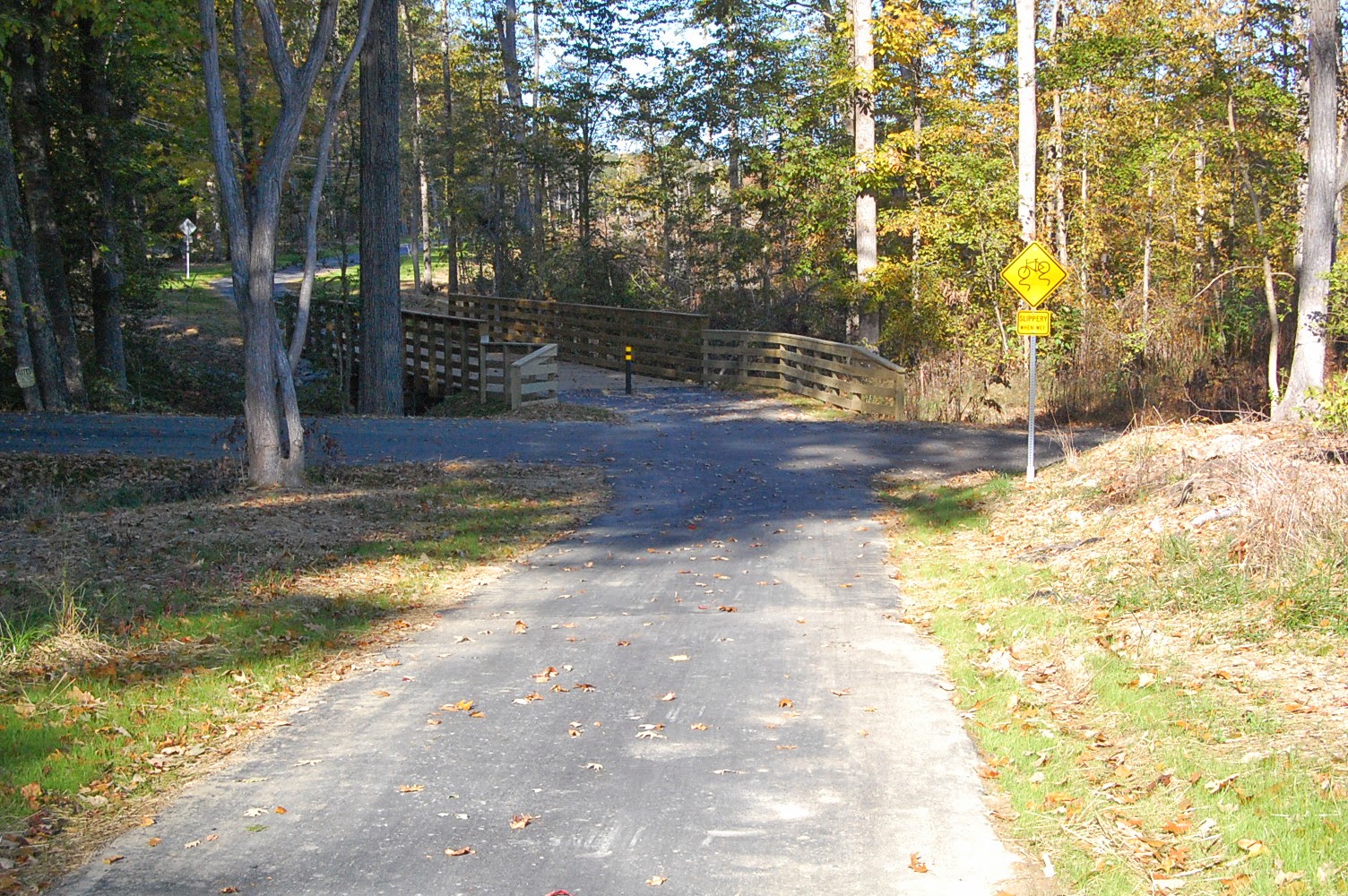
Since moving to Williamsburg I've been waiting, waiting, waiting for the unfinished Virginia Capital Trail to be complete. Finally, finally, finally the Sherwood Forest section has been completed! The official dedication took place on October 15th, but the trail was open to biking a few weeks before the 15th. The Sherwood Forest section runs along Route 5 from just west of the Chickahominy River Bridge to Charles City. I took some pictures along this wonderful new trail on a sunny fall morning. Share the scenery with me as we ride westward from Chickahominy to Charles City.
The newly completed trail begins with these views after crossing the Chickahominy River Bridge.
The trail runs parallel to Route 5, sometimes very close to the highway.
Historic signs are posted just before the intersection with Wilcox Neck Road (623). The intersection itself is not particularly busy.
The next segment, between Wilcox Neck Road and Sandy Point Road, has some nice wooded sections, although it never strays far from Route 5.
After passing Sandy Point Road wooden bridges become more common.
At Sturgeon Point Road another set of historical signs are nicely placed beside the trail.
A beautiful tree-lined stretch brings the trail past the entrance to Sherwood Forest.
One of the prettiest parts of the trail is just past Sherwood Forest. Fields of ripening soybeans glowed yellow in the late morning sun. Long open lines of sight look out over farmland.
Within a few miles of Charles City more wooden bridges appear.
After crossing the wooden bridge above a long open section passes fields surrounding the Burlington Plantation on the left.
Charles City is not far away now - just beyond this long bridge.
The trail crosses to the south side of Route 5 just before Charles City and then passes through this brief scenic stretch.
At the intersection of Route 5 and Route 155 the trail swings up into Charles City on a concrete sidewalk.
Charles City is not what most people would call a city. It's a small collection of county administrative buildings and a visitor center at the historic Charles City Courthouse. Here's the historic old courthouse.
There seems to be a conflict between the construction dates on the two signs. Was the old courthouse built in 1730, or 1757? Across the road from the old courthouse is the Courthouse Grill.
A short ride down this road through Charles City leads to the continuation of the Capital Trail which goes on for about another 7 paved miles at this time.
Charles City is just about at the 20-mile point along the Capital Trail. The zero-mile point is located at the Jamestown Settlement. It's a beautiful ride on a sunny fall day!
Subscribe to:
Posts (Atom)
People say I'm crazy doing what I'm doing
Well they give me all kinds of warnings to save me from ruin
When I say that I'm o.k. well they look at me kind of strange
Surely you're not happy now you no longer play the game
People say I'm lazy dreaming my life away
Well they give me all kinds of advice designed to enlighten me
When I tell them that I'm doing fine watching shadows on the wall
Don't you miss the big time boy you're no longer on the ball
I'm just sitting here watching the wheels go round and round
I really love to watch them roll
No longer riding on the merry-go-round
I just had to let it go
John Lennon