Monday, August 12, 2019

Magnified Insects

More Microscope Pics

In one of Busch Gardens' many well-kept flower beds we saw what looked like a large bee flying from flower to flower. On closer inspection we noticed the "bee" had a flat tail area unlike any familiar bee. I believe we saw a Hummingbird Moth with yellow and black coloring. It really resembles a bee at first glance as you can see in the following picture.
Just a few feet from the Hummingbird Moth a yellow Eastern Tiger Swallowtail butterfly fluttered from blossom to blossom.
A Painted Lady butterfly is also present in the upper left corner of the previous picture.

Lots of Tiger Swallowtails are flying about these days, and they frequently collide with cars. I found a well-preserved dead specimen in a parking lot. Under the microscope details of its head were revealed.
Since the eyes and coiled proboscis are different distances from the microscope lens, they are not simultaneously in focus. The next picture focused on the coiled proboscis.
The next image focused on part of the eye closest to the lens. (The bright silver-colored eye area is a reflection of the bright overhead light source.)
Next is a magnified portion of the colorful butterfly wing.
Since the wing was nearly flat, it was possible to bring the crescent-shaped yellow portion above into focus at higher magnification.
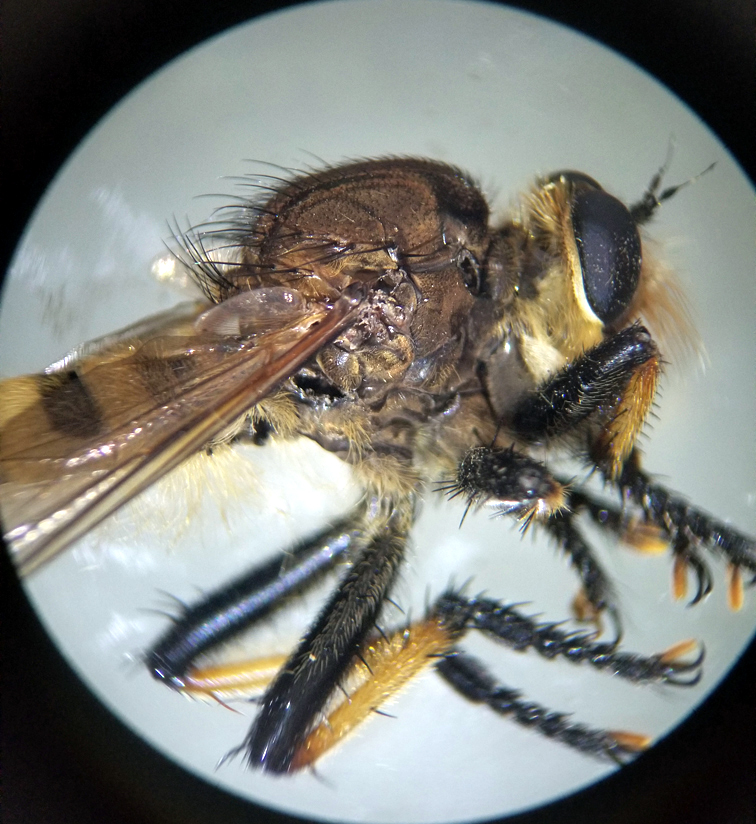
A dead Robber Fly from my front porch was a good subject to magnify. Check out the claws on its legs.
Next is a side and top view of the tail.
Notice the small dark oval opening just to the left of the neck in the next picture.
When I magnified the oval opening I noticed movement! An ant was feeding inside the body of the fly! One of the ant's antennae is emerging from the cavity in the close view below. Part of the ant's head is also visible within the hole.
I still marvel at the microscope's wonderful ability to reveal things hidden from normal sight.  

Monday, July 29, 2019

Phone-to Eyepiece Pictures

Microscope Pics

I've had mixed results using a new Celestron NexYZ phone-to-eyepiece holder on several devices. The best results came with the NexYZ attached to one of my binocular microscopes. My granddaughter, Sophie, likes to bring me dead bugs and other curious bits to examine together through the microscope. For example, here's a grasshopper leg.
We found a dead dragonfly during our recent trip to the NC shore. The facets on portions of its compound eye are visible in the next pictures, especially the second magnified one. (Click on the images for a better view.) The bright patches on the eyes are reflections from an overhead light source.
One of the dragonfly's legs looked different from the grasshopper leg above.
Sophie also found lots of crab parts on the beach. I never noticed how they were encrusted with sand until I looked at the magnified image. The sand grains are clear quartz, seen more clearly in the second image below.
Sophie also found a bird feather on the beach. The feather's tip looked like this.
While my phone was well attached to the microscope I decided to examine some fossils I've collected over the years. Some fossils only show up clearly under magnification. For example, this piece of limestone from near Lexington, VA looks almost blank to the unaided eye, but shows some shells and what I think is a portion of a Cryptolithus trilobite under magnification. The trilobite portion is the curved series of dots just to the left of the shell near the upper right edge.
I think Sophie might like seeing magnified microscope images on a phone screen rather than trying to match her small eye spacing to binocular eyepieces designed for adults. 

Tuesday, July 9, 2019

Currituck Lighthouse

Sights Near Corolla

While at the NC shore we decided to drive north along Highway 12 to explore areas we hadn't seen before. We found diminishing traffic, palatial shopping centers, large houses, and lovely Historic Corolla Park featuring the Currituck Lighthouse.
Lighthouse construction began in 1873 and was completed in 1875.
The lighthouse sits in a pretty shaded area featuring old restored buildings connected by brick walking paths. (Click on the following panorama to get a better idea of the layout.)
The lighthouse keepers' house, completed in 1876, (seen on the left in the panorama above), housed two families. It was restored and moved to its present position. A smaller house was moved to the location in 1920 and served as a home for a third keeper and his family. The smaller house, seen in the picture below, is now a museum shop filled with interesting items.
Park land extends far from the lighthouse itself. Here's a view looking back towards the lighthouse from the grounds of a "hunting lodge" built by wealthy landowners during the 1920's. A boathouse and lagoon appear in the foreground.
The view from near the boathouse itself reveals an attractive restored wooden bridge spanning the lagoon's exit into the neighboring sound.
The yellow "hunting lodge", seen in the next picture, was built by a wealthy couple, Edward Collings Wright Jr. and his wife, Marie Louise. Construction began in 1922 and was completed in 1925.
As we circled the house we saw enormous numbers of mosquitoes perched on the side just waiting for evening.
It was a pleasant surprise to find these attractions conveniently close to our vacation house.


Tuesday, July 2, 2019

Beach Fun

Southern Shores

We enjoyed a nice week at the North Carolina shore recently where our rental house was conveniently located a short distance from the beach. My daughter's happy family headed off to the ocean every day with their load of equipment.
Granddaughter Sophie is a joy to watch as she jumps over waves and frolics in the surf.
All week we had lucky weather and a calm ocean.
The smooth sea allowed paddle boarding near shore.
Annabelle sat in her pool with grandma.
Sometimes Annabelle even used her float in the ocean.
Sophie and Keegan launched a kite with boundless energy.
Sophie was fascinated by swarms of small crabs continually scurrying on the beach and popping in and out of the sand. She displayed crab parts on a beach chair so I could see the ones she collected.
One pleasant evening we strolled along the Duck Boardwalk where attractive scenes near sunset included: an isolated tree backlit by the setting Sun, seagulls on a wharf, a sunlit ripple pattern, and an osprey nest.
Some nice folks were kind enough to take this family portrait in front of the colorful sunset.
Back at the beach house we worked on the traditional jigsaw puzzle. Ellen and I became obsessed with completing the puzzle. We couldn't walk past without stopping to put a few pieces in place.
We chose a beautiful thousand-piece puzzle with lots of clearly defined lines and edges. (Last year's uncompleted puzzle, with lots of undifferentiated blue sky, was a nightmare.) This year we were happy to finish, although three pieces were missing in the end.
On our last morning Sophie wanted to see the Sun rise over the ocean, so the family went to the beach before dawn. Fortunately, the sky was clear down to the horizon, so sunrise was visible.
We've had two good years at this beach house and hope to return next year. 

Friday, June 7, 2019

Eyes on Eyepieces

Pleasant Evening

Modern cameras produce beautiful astronomical images. They reveal much more than the eye alone can see. But it's still wonderful to see celestial sights through a telescope with your own eyes. It's especially wonderful when you see things for the first time! We had a rare, cloud free night on June 3rd, and my bright young friend, Luisa, came to share some astronomical observing time with my Stellarvue 130mm refractor.
After overcoming initial telescope/mount pointing problems we settled down for more than two hours of fun. We attached eyepieces instead of cameras and decided to look at a sample of celestial wonders.

We saw six globular clusters: M13, M92, M12, M10, M5, and M4.

We saw six attractive double stars: Mizar, Albireo, Cor Caroli, Epsilon Lyrae, Acrab, and Algieba.

We saw the galaxy pair M81/M82, just capturing both in one field of view.

Open cluster M11 looked great, and the Ring Nebula M57 was spectacular.

The Swan Nebula, M17, showed some glowing gas, but only a hint of glow was apparent in the Lagoon Nebula, M8.

Louisa wanted to see how individual bright stars appeared through the telescope, so we looked at Vega, Spica, and Regulus. I also showed her the dim, but very red carbon star, T Lyrae.

By about 11:30 Jupiter had risen above the murky horizon. Luisa loved seeing Jovian moons arrayed beside Jupiter. I placed my phone on the eyepiece to grab the quick low quality picture of Jupiter shown below.
Jupiter is greatly overexposed, but you can see three moons beside the giant planet. Callisto is the moon on the bottom left. Europa is the moon closest to Jupiter on the right, and Ganymede is the remaining moon in the upper right. (The fourth Galilean moon, Io, was out of sight behind Jupiter.) The small dim object in line between Europa and Ganymede is actually a 9th magnitude background star called HD156182 which just happened to be aligned with the moons' orbital plane. Cloud bands on Jupiter were clearly visible to our eyes, but the phone camera wasn't smart enough to simultaneously capture both bright Jupiter and its relatively dimmer moons.

Saturn and its rings were near the horizon and showed a pleasing yellowish color in the eyepiece.

The telescope gave nice views, but we also saw some interesting naked eye events. The International Space Station passed over twice. Luisa saw a meteor streak across the sky. We also saw a tumbling satellite alternating in brightness as it traveled across constellations.

Eventually, some hazy clouds began appearing, and we were both getting tired after midnight. After the equipment was brought inside our exciting night was not quite finished. As I drove Luisa home at 1:00 am we passed hundreds of deer feeding along the roadsides, including one young buck who stood calmly in the middle of the highway blocking our way. I was astounded by the number of deer and glowing eyeballs reflecting our headlights! I drove well below the speed limit to avoid hitting them.

Luisa will soon return to Brazil. Farewell, Luisa! I'll miss you. 


Wednesday, May 29, 2019

Framed Rainbow

Rural Scene

While visiting my niece on May 25th in rural Orange, Virginia a late afternoon rainbow appeared attractively framed by backyard trees.
The background clouds are not very dark, so rainbow colors are not as dramatic as they could be.

A few moments before the previous picture was taken colors were slightly more intense.
The rainbow added extra beauty to the pleasant countryside visible from my niece's house.

People say I'm crazy doing what I'm doing
Well they give me all kinds of warnings to save me from ruin
When I say that I'm o.k. well they look at me kind of strange
Surely you're not happy now you no longer play the game

People say I'm lazy dreaming my life away
Well they give me all kinds of advice designed to enlighten me
When I tell them that I'm doing fine watching shadows on the wall
Don't you miss the big time boy you're no longer on the ball

I'm just sitting here watching the wheels go round and round
I really love to watch them roll
No longer riding on the merry-go-round
I just had to let it go

John Lennon