Nice Little Bike Trip
One recent afternoon I took a pleasant bike ride with my granddaughter, Sophie. We rode along wonderful local bike trails towards the original historic Jamestown site. In 1608, just one year after the Jamestown colony was established, glass workers, some from Poland, set up a primitive glass making factory on the bank of the James River near Jamestown. Archeologists have uncovered ruins of this more than 400 year-old enterprise. The remnants of the furnace and kiln are now preserved within the dim interior of a wooden shelter. We parked our bikes outside.
Inside, ruins are surrounded by glass walls. It's hard to get pictures without also capturing reflections from the protective glass barriers.
I'm sure the riverbank has changed over the past 400 years. Now, in 2019, the original glasshouse is only several feet away from the James River. Sophie walked over to the tiny beach and dodged small waves lapping the shore. The Jamestown River Ferry can be seen in the background.
About 30 yards away from the historic glass-making ruins there is a working modern glasshouse where expert reenactors make glassware in front of spectators. I think this is one of the best attractions in the Williamsburg area! The natural gas powered furnace is impressive. We were told the sandy mixture, which eventually becomes molten glass, is heated to 2400 F degrees. Yellow blackbody radiation streams from the incandescent furnace interior.
There's access to more molten glass on the other side of the furnace.
Sophie listened to a kind gentleman who explained the process.
At the time of our visit they were making green colored glass into old fashioned wine bottles like this one.
Notice the seal imprinted on the bottom bulge and the lip around the top of the neck.
The wine bottle begins as a bit of molten glass drawn from the furnace on the end of a long metal rod.
The glass worker rolls the glass glob into a cylinder.
Then he blows into the hollow metal rod to begin opening the interior of the bottle.
Eventually, he steps up and blows out the bulge shape of the bottle's bottom.
The hot bottle is then carried over to a place where a bit of molten glass is dropped onto the bulge and pressed into the side by a seal stamp. In the next picture you can see the glowing yellow glass blob that will be mashed down by the stamp.
After the seal is in place, the lip around the bottle's thin neck is produced. A seated glass worker rotates the bottle while a hanging string of molten glass wraps around the neck. Unfortunately, I didn't get a good still shot of this step, so I had to grab the low quality individual video frame shown next.
The wine bottle is only one member of a large variety of glassware available in the accompanying gift shop. A small sample of many other items produced by glasshouse craftsmen can be seen behind Sophie.
After our glasshouse visit we took a longer, different bike route home. We saw a doe and fawn near a beaver dam along the way. I'm looking forward to more bike rides with Sophie!
Sunday, September 1, 2019
Monday, August 12, 2019
Magnified Insects
More Microscope Pics
In one of Busch Gardens' many well-kept flower beds we saw what looked like a large bee flying from flower to flower. On closer inspection we noticed the "bee" had a flat tail area unlike any familiar bee. I believe we saw a Hummingbird Moth with yellow and black coloring. It really resembles a bee at first glance as you can see in the following picture.
Just a few feet from the Hummingbird Moth a yellow Eastern Tiger Swallowtail butterfly fluttered from blossom to blossom.
A Painted Lady butterfly is also present in the upper left corner of the previous picture.
Lots of Tiger Swallowtails are flying about these days, and they frequently collide with cars. I found a well-preserved dead specimen in a parking lot. Under the microscope details of its head were revealed.
Since the eyes and coiled proboscis are different distances from the microscope lens, they are not simultaneously in focus. The next picture focused on the coiled proboscis.
The next image focused on part of the eye closest to the lens. (The bright silver-colored eye area is a reflection of the bright overhead light source.)
Next is a magnified portion of the colorful butterfly wing.
Since the wing was nearly flat, it was possible to bring the crescent-shaped yellow portion above into focus at higher magnification.
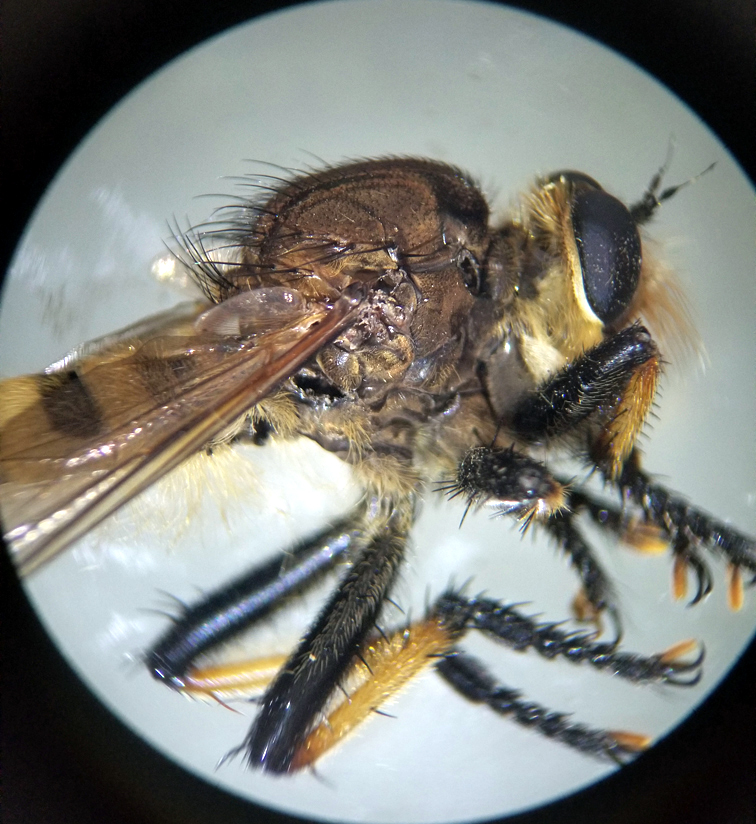
A dead Robber Fly from my front porch was a good subject to magnify. Check out the claws on its legs.
Next is a side and top view of the tail.
Notice the small dark oval opening just to the left of the neck in the next picture.
When I magnified the oval opening I noticed movement! An ant was feeding inside the body of the fly! One of the ant's antennae is emerging from the cavity in the close view below. Part of the ant's head is also visible within the hole.
I still marvel at the microscope's wonderful ability to reveal things hidden from normal sight.
In one of Busch Gardens' many well-kept flower beds we saw what looked like a large bee flying from flower to flower. On closer inspection we noticed the "bee" had a flat tail area unlike any familiar bee. I believe we saw a Hummingbird Moth with yellow and black coloring. It really resembles a bee at first glance as you can see in the following picture.
Just a few feet from the Hummingbird Moth a yellow Eastern Tiger Swallowtail butterfly fluttered from blossom to blossom.
A Painted Lady butterfly is also present in the upper left corner of the previous picture.
Lots of Tiger Swallowtails are flying about these days, and they frequently collide with cars. I found a well-preserved dead specimen in a parking lot. Under the microscope details of its head were revealed.
Since the eyes and coiled proboscis are different distances from the microscope lens, they are not simultaneously in focus. The next picture focused on the coiled proboscis.
The next image focused on part of the eye closest to the lens. (The bright silver-colored eye area is a reflection of the bright overhead light source.)
Next is a magnified portion of the colorful butterfly wing.
Since the wing was nearly flat, it was possible to bring the crescent-shaped yellow portion above into focus at higher magnification.
Monday, July 29, 2019
Phone-to Eyepiece Pictures
Microscope Pics
I've had mixed results using a new Celestron NexYZ phone-to-eyepiece holder on several devices. The best results came with the NexYZ attached to one of my binocular microscopes. My granddaughter, Sophie, likes to bring me dead bugs and other curious bits to examine together through the microscope. For example, here's a grasshopper leg.
We found a dead dragonfly during our recent trip to the NC shore. The facets on portions of its compound eye are visible in the next pictures, especially the second magnified one. (Click on the images for a better view.) The bright patches on the eyes are reflections from an overhead light source.
One of the dragonfly's legs looked different from the grasshopper leg above.
Sophie also found lots of crab parts on the beach. I never noticed how they were encrusted with sand until I looked at the magnified image. The sand grains are clear quartz, seen more clearly in the second image below.
Sophie also found a bird feather on the beach. The feather's tip looked like this.
While my phone was well attached to the microscope I decided to examine some fossils I've collected over the years. Some fossils only show up clearly under magnification. For example, this piece of limestone from near Lexington, VA looks almost blank to the unaided eye, but shows some shells and what I think is a portion of a Cryptolithus trilobite under magnification. The trilobite portion is the curved series of dots just to the left of the shell near the upper right edge.
I think Sophie might like seeing magnified microscope images on a phone screen rather than trying to match her small eye spacing to binocular eyepieces designed for adults.
I've had mixed results using a new Celestron NexYZ phone-to-eyepiece holder on several devices. The best results came with the NexYZ attached to one of my binocular microscopes. My granddaughter, Sophie, likes to bring me dead bugs and other curious bits to examine together through the microscope. For example, here's a grasshopper leg.
We found a dead dragonfly during our recent trip to the NC shore. The facets on portions of its compound eye are visible in the next pictures, especially the second magnified one. (Click on the images for a better view.) The bright patches on the eyes are reflections from an overhead light source.
One of the dragonfly's legs looked different from the grasshopper leg above.
Sophie also found lots of crab parts on the beach. I never noticed how they were encrusted with sand until I looked at the magnified image. The sand grains are clear quartz, seen more clearly in the second image below.
Sophie also found a bird feather on the beach. The feather's tip looked like this.
While my phone was well attached to the microscope I decided to examine some fossils I've collected over the years. Some fossils only show up clearly under magnification. For example, this piece of limestone from near Lexington, VA looks almost blank to the unaided eye, but shows some shells and what I think is a portion of a Cryptolithus trilobite under magnification. The trilobite portion is the curved series of dots just to the left of the shell near the upper right edge.
I think Sophie might like seeing magnified microscope images on a phone screen rather than trying to match her small eye spacing to binocular eyepieces designed for adults.
Tuesday, July 9, 2019
Currituck Lighthouse
Sights Near Corolla
While at the NC shore we decided to drive north along Highway 12 to explore areas we hadn't seen before. We found diminishing traffic, palatial shopping centers, large houses, and lovely Historic Corolla Park featuring the Currituck Lighthouse.
Lighthouse construction began in 1873 and was completed in 1875.
The lighthouse sits in a pretty shaded area featuring old restored buildings connected by brick walking paths. (Click on the following panorama to get a better idea of the layout.)
The lighthouse keepers' house, completed in 1876, (seen on the left in the panorama above), housed two families. It was restored and moved to its present position. A smaller house was moved to the location in 1920 and served as a home for a third keeper and his family. The smaller house, seen in the picture below, is now a museum shop filled with interesting items.
Park land extends far from the lighthouse itself. Here's a view looking back towards the lighthouse from the grounds of a "hunting lodge" built by wealthy landowners during the 1920's. A boathouse and lagoon appear in the foreground.
The view from near the boathouse itself reveals an attractive restored wooden bridge spanning the lagoon's exit into the neighboring sound.
The yellow "hunting lodge", seen in the next picture, was built by a wealthy couple, Edward Collings Wright Jr. and his wife, Marie Louise. Construction began in 1922 and was completed in 1925.
As we circled the house we saw enormous numbers of mosquitoes perched on the side just waiting for evening.
It was a pleasant surprise to find these attractions conveniently close to our vacation house.
While at the NC shore we decided to drive north along Highway 12 to explore areas we hadn't seen before. We found diminishing traffic, palatial shopping centers, large houses, and lovely Historic Corolla Park featuring the Currituck Lighthouse.
Lighthouse construction began in 1873 and was completed in 1875.
The lighthouse sits in a pretty shaded area featuring old restored buildings connected by brick walking paths. (Click on the following panorama to get a better idea of the layout.)
The lighthouse keepers' house, completed in 1876, (seen on the left in the panorama above), housed two families. It was restored and moved to its present position. A smaller house was moved to the location in 1920 and served as a home for a third keeper and his family. The smaller house, seen in the picture below, is now a museum shop filled with interesting items.
Park land extends far from the lighthouse itself. Here's a view looking back towards the lighthouse from the grounds of a "hunting lodge" built by wealthy landowners during the 1920's. A boathouse and lagoon appear in the foreground.
The view from near the boathouse itself reveals an attractive restored wooden bridge spanning the lagoon's exit into the neighboring sound.
The yellow "hunting lodge", seen in the next picture, was built by a wealthy couple, Edward Collings Wright Jr. and his wife, Marie Louise. Construction began in 1922 and was completed in 1925.
As we circled the house we saw enormous numbers of mosquitoes perched on the side just waiting for evening.
It was a pleasant surprise to find these attractions conveniently close to our vacation house.
Tuesday, July 2, 2019
Beach Fun
Southern Shores
We enjoyed a nice week at the North Carolina shore recently where our rental house was conveniently located a short distance from the beach. My daughter's happy family headed off to the ocean every day with their load of equipment.
Granddaughter Sophie is a joy to watch as she jumps over waves and frolics in the surf.
All week we had lucky weather and a calm ocean.
The smooth sea allowed paddle boarding near shore.
Annabelle sat in her pool with grandma.
Sometimes Annabelle even used her float in the ocean.
Sophie and Keegan launched a kite with boundless energy.
Sophie was fascinated by swarms of small crabs continually scurrying on the beach and popping in and out of the sand. She displayed crab parts on a beach chair so I could see the ones she collected.
One pleasant evening we strolled along the Duck Boardwalk where attractive scenes near sunset included: an isolated tree backlit by the setting Sun, seagulls on a wharf, a sunlit ripple pattern, and an osprey nest.
Some nice folks were kind enough to take this family portrait in front of the colorful sunset.
Back at the beach house we worked on the traditional jigsaw puzzle. Ellen and I became obsessed with completing the puzzle. We couldn't walk past without stopping to put a few pieces in place.
We chose a beautiful thousand-piece puzzle with lots of clearly defined lines and edges. (Last year's uncompleted puzzle, with lots of undifferentiated blue sky, was a nightmare.) This year we were happy to finish, although three pieces were missing in the end.
On our last morning Sophie wanted to see the Sun rise over the ocean, so the family went to the beach before dawn. Fortunately, the sky was clear down to the horizon, so sunrise was visible.
We've had two good years at this beach house and hope to return next year.
We enjoyed a nice week at the North Carolina shore recently where our rental house was conveniently located a short distance from the beach. My daughter's happy family headed off to the ocean every day with their load of equipment.
Granddaughter Sophie is a joy to watch as she jumps over waves and frolics in the surf.
All week we had lucky weather and a calm ocean.
The smooth sea allowed paddle boarding near shore.
Annabelle sat in her pool with grandma.
Sometimes Annabelle even used her float in the ocean.
Sophie and Keegan launched a kite with boundless energy.
Sophie was fascinated by swarms of small crabs continually scurrying on the beach and popping in and out of the sand. She displayed crab parts on a beach chair so I could see the ones she collected.
One pleasant evening we strolled along the Duck Boardwalk where attractive scenes near sunset included: an isolated tree backlit by the setting Sun, seagulls on a wharf, a sunlit ripple pattern, and an osprey nest.
Some nice folks were kind enough to take this family portrait in front of the colorful sunset.
Back at the beach house we worked on the traditional jigsaw puzzle. Ellen and I became obsessed with completing the puzzle. We couldn't walk past without stopping to put a few pieces in place.
We chose a beautiful thousand-piece puzzle with lots of clearly defined lines and edges. (Last year's uncompleted puzzle, with lots of undifferentiated blue sky, was a nightmare.) This year we were happy to finish, although three pieces were missing in the end.
On our last morning Sophie wanted to see the Sun rise over the ocean, so the family went to the beach before dawn. Fortunately, the sky was clear down to the horizon, so sunrise was visible.
We've had two good years at this beach house and hope to return next year.
Subscribe to:
Posts (Atom)
People say I'm crazy doing what I'm doing
Well they give me all kinds of warnings to save me from ruin
When I say that I'm o.k. well they look at me kind of strange
Surely you're not happy now you no longer play the game
People say I'm lazy dreaming my life away
Well they give me all kinds of advice designed to enlighten me
When I tell them that I'm doing fine watching shadows on the wall
Don't you miss the big time boy you're no longer on the ball
I'm just sitting here watching the wheels go round and round
I really love to watch them roll
No longer riding on the merry-go-round
I just had to let it go
John Lennon