Lovely Palm Cove
Before our recent trip to Australia I had never been south of the equator. When an astronomy themed Australian tour became available it was a good opportunity to visit a new continent. I was hoping to see lots of new things, including celestial objects in the southern skies not visible from home.
It was a long journey across the globe, even longer than our previous grueling trips to South Korea. It took four different flights and three layovers to reach our destination.
We crossed several time zones, the equator, and the International Dateline.
The last flight finally took us from Brisbane to Cairns, arriving more than 35 hours after leaving home. (Cairns is pronounced, Ken's by Australians.) Our plane for the long Pacific Ocean flight was a Boeing 787-9 seen below in the Brisbane airport.
It was a relief to arrive at the Cairns airport and anticipate immediate escape from airplane/airport madness. While waiting for our luggage we saw this exhibit of an amazing decorated triathlon bike.
At last we stepped outside into warm, sunny, Australian weather where we met our tour director and some fellow tourists.
Soon we were driving to our hotel in Palm Cove. I was delighted to see this sign along the way.
We passed several fields of sugar cane near Cairns as we drove along. The harvested sugar cane was transported on dedicated, very narrow gauge rail lines running along the field edges. The tiny width between rails reminded me of miniature toy railroads I rode as a kid.
It wasn't long before we arrived at our hotel, The Reef House, in Palm Cove. The front entrance is seen below.
What a lovely place this was! The tour was off to a great start as we left luggage in our nice room.
Here are views from our back patio looking out at a central courtyard with a walkway in back.
A swimming pool was centered in the inner courtyard.
The Reef House had a beautiful lounge area with games, books, videos, and paintings.
The hotel had an open front and dining area where mild, fresh breezes gently blew.
Huge old paperbark gum trees lined the hotel entrance. They were said to have been there since the time of Captain Cook in 1770!
The interesting bark could be peeled off and used in the past as bedding, or, soaked in water to become a food wrap for cooking.
This beautiful beach was directly in front of the hotel.
A gorgeous palm-lined sidewalk was wonderful for slowly strolling along the shoreline.
Along with beauty came possible hazards: dangerous stinging jellyfish and some reptiles.
Dangers were easily avoided. We were intoxicated by tropical beauty greeting us each morning. Elusive colorful birds flashed by making unfamiliar calls.
We passed by this scene each morning as we left the hotel.
On the evening of our arrival we traveled to the Thala resort for dinner and possible stargazing. A non-ideal viewing site and partly cloudy skies made stargazing disappointing. Instead of being located on high ground with clear views of the surrounding horizon, the viewing site was on lower ground surrounded by high trees. The Moon wasn't yet bright enough to overwhelm the Milky Way, but trees blocked the brightest parts, and clouds kept interfering. I could see the Small Magellanic Cloud in binoculars, but my phone camera couldn't capture it in a 10-second exposure. I did see globular cluster 47 Tucanae in the telescope provided. Only two of my phone images were marginally worthwhile. I removed color from the images and processed them to show one bright Milky Way section near Sagittarius. This bright area is just below and left of center in the next picture. The dark shapes across the bottom are trees.
Sagittarius was higher above the horizon than at home and oriented differently. Corona Australis, visible as a curved, upside down arc of stars left of center is visible in both pictures. In the second picture, taken a little later than the first, bright Jupiter appeared through a gap in the trees below center. Saturn is also visible higher up above the glow in Sagittarius.
I'm very disappointed in these images. My phone camera obviously isn't the best instrument for capturing dark sky details, but I expected better results. The constant march of clouds and unfortunate background lighting didn't help. Nevertheless, I was happy to see two southern hemisphere celestial sights I had never seen before.
After the stargazing we drove back to Palm Cove anticipating adventures the next day.
Wednesday, October 16, 2019
Sunday, September 1, 2019
Jamestown Glass House
Nice Little Bike Trip
One recent afternoon I took a pleasant bike ride with my granddaughter, Sophie. We rode along wonderful local bike trails towards the original historic Jamestown site. In 1608, just one year after the Jamestown colony was established, glass workers, some from Poland, set up a primitive glass making factory on the bank of the James River near Jamestown. Archeologists have uncovered ruins of this more than 400 year-old enterprise. The remnants of the furnace and kiln are now preserved within the dim interior of a wooden shelter. We parked our bikes outside.
Inside, ruins are surrounded by glass walls. It's hard to get pictures without also capturing reflections from the protective glass barriers.
I'm sure the riverbank has changed over the past 400 years. Now, in 2019, the original glasshouse is only several feet away from the James River. Sophie walked over to the tiny beach and dodged small waves lapping the shore. The Jamestown River Ferry can be seen in the background.
About 30 yards away from the historic glass-making ruins there is a working modern glasshouse where expert reenactors make glassware in front of spectators. I think this is one of the best attractions in the Williamsburg area! The natural gas powered furnace is impressive. We were told the sandy mixture, which eventually becomes molten glass, is heated to 2400 F degrees. Yellow blackbody radiation streams from the incandescent furnace interior.
There's access to more molten glass on the other side of the furnace.
Sophie listened to a kind gentleman who explained the process.
At the time of our visit they were making green colored glass into old fashioned wine bottles like this one.
Notice the seal imprinted on the bottom bulge and the lip around the top of the neck.
The wine bottle begins as a bit of molten glass drawn from the furnace on the end of a long metal rod.
The glass worker rolls the glass glob into a cylinder.
Then he blows into the hollow metal rod to begin opening the interior of the bottle.
Eventually, he steps up and blows out the bulge shape of the bottle's bottom.
The hot bottle is then carried over to a place where a bit of molten glass is dropped onto the bulge and pressed into the side by a seal stamp. In the next picture you can see the glowing yellow glass blob that will be mashed down by the stamp.
After the seal is in place, the lip around the bottle's thin neck is produced. A seated glass worker rotates the bottle while a hanging string of molten glass wraps around the neck. Unfortunately, I didn't get a good still shot of this step, so I had to grab the low quality individual video frame shown next.
The wine bottle is only one member of a large variety of glassware available in the accompanying gift shop. A small sample of many other items produced by glasshouse craftsmen can be seen behind Sophie.
After our glasshouse visit we took a longer, different bike route home. We saw a doe and fawn near a beaver dam along the way. I'm looking forward to more bike rides with Sophie!
One recent afternoon I took a pleasant bike ride with my granddaughter, Sophie. We rode along wonderful local bike trails towards the original historic Jamestown site. In 1608, just one year after the Jamestown colony was established, glass workers, some from Poland, set up a primitive glass making factory on the bank of the James River near Jamestown. Archeologists have uncovered ruins of this more than 400 year-old enterprise. The remnants of the furnace and kiln are now preserved within the dim interior of a wooden shelter. We parked our bikes outside.
Inside, ruins are surrounded by glass walls. It's hard to get pictures without also capturing reflections from the protective glass barriers.
I'm sure the riverbank has changed over the past 400 years. Now, in 2019, the original glasshouse is only several feet away from the James River. Sophie walked over to the tiny beach and dodged small waves lapping the shore. The Jamestown River Ferry can be seen in the background.
About 30 yards away from the historic glass-making ruins there is a working modern glasshouse where expert reenactors make glassware in front of spectators. I think this is one of the best attractions in the Williamsburg area! The natural gas powered furnace is impressive. We were told the sandy mixture, which eventually becomes molten glass, is heated to 2400 F degrees. Yellow blackbody radiation streams from the incandescent furnace interior.
There's access to more molten glass on the other side of the furnace.
Sophie listened to a kind gentleman who explained the process.
At the time of our visit they were making green colored glass into old fashioned wine bottles like this one.
Notice the seal imprinted on the bottom bulge and the lip around the top of the neck.
The wine bottle begins as a bit of molten glass drawn from the furnace on the end of a long metal rod.
The glass worker rolls the glass glob into a cylinder.
Then he blows into the hollow metal rod to begin opening the interior of the bottle.
Eventually, he steps up and blows out the bulge shape of the bottle's bottom.
The hot bottle is then carried over to a place where a bit of molten glass is dropped onto the bulge and pressed into the side by a seal stamp. In the next picture you can see the glowing yellow glass blob that will be mashed down by the stamp.
After the seal is in place, the lip around the bottle's thin neck is produced. A seated glass worker rotates the bottle while a hanging string of molten glass wraps around the neck. Unfortunately, I didn't get a good still shot of this step, so I had to grab the low quality individual video frame shown next.
The wine bottle is only one member of a large variety of glassware available in the accompanying gift shop. A small sample of many other items produced by glasshouse craftsmen can be seen behind Sophie.
After our glasshouse visit we took a longer, different bike route home. We saw a doe and fawn near a beaver dam along the way. I'm looking forward to more bike rides with Sophie!
Monday, August 12, 2019
Magnified Insects
More Microscope Pics
In one of Busch Gardens' many well-kept flower beds we saw what looked like a large bee flying from flower to flower. On closer inspection we noticed the "bee" had a flat tail area unlike any familiar bee. I believe we saw a Hummingbird Moth with yellow and black coloring. It really resembles a bee at first glance as you can see in the following picture.
Just a few feet from the Hummingbird Moth a yellow Eastern Tiger Swallowtail butterfly fluttered from blossom to blossom.
A Painted Lady butterfly is also present in the upper left corner of the previous picture.
Lots of Tiger Swallowtails are flying about these days, and they frequently collide with cars. I found a well-preserved dead specimen in a parking lot. Under the microscope details of its head were revealed.
Since the eyes and coiled proboscis are different distances from the microscope lens, they are not simultaneously in focus. The next picture focused on the coiled proboscis.
The next image focused on part of the eye closest to the lens. (The bright silver-colored eye area is a reflection of the bright overhead light source.)
Next is a magnified portion of the colorful butterfly wing.
Since the wing was nearly flat, it was possible to bring the crescent-shaped yellow portion above into focus at higher magnification.
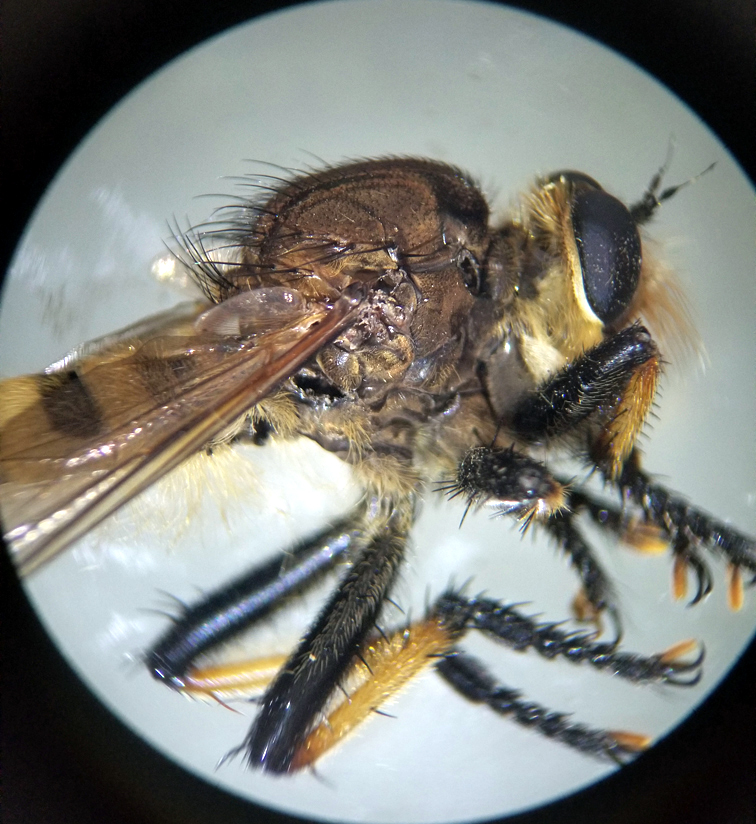
A dead Robber Fly from my front porch was a good subject to magnify. Check out the claws on its legs.
Next is a side and top view of the tail.
Notice the small dark oval opening just to the left of the neck in the next picture.
When I magnified the oval opening I noticed movement! An ant was feeding inside the body of the fly! One of the ant's antennae is emerging from the cavity in the close view below. Part of the ant's head is also visible within the hole.
I still marvel at the microscope's wonderful ability to reveal things hidden from normal sight.
In one of Busch Gardens' many well-kept flower beds we saw what looked like a large bee flying from flower to flower. On closer inspection we noticed the "bee" had a flat tail area unlike any familiar bee. I believe we saw a Hummingbird Moth with yellow and black coloring. It really resembles a bee at first glance as you can see in the following picture.
Just a few feet from the Hummingbird Moth a yellow Eastern Tiger Swallowtail butterfly fluttered from blossom to blossom.
A Painted Lady butterfly is also present in the upper left corner of the previous picture.
Lots of Tiger Swallowtails are flying about these days, and they frequently collide with cars. I found a well-preserved dead specimen in a parking lot. Under the microscope details of its head were revealed.
Since the eyes and coiled proboscis are different distances from the microscope lens, they are not simultaneously in focus. The next picture focused on the coiled proboscis.
The next image focused on part of the eye closest to the lens. (The bright silver-colored eye area is a reflection of the bright overhead light source.)
Next is a magnified portion of the colorful butterfly wing.
Since the wing was nearly flat, it was possible to bring the crescent-shaped yellow portion above into focus at higher magnification.
Subscribe to:
Posts (Atom)
People say I'm crazy doing what I'm doing
Well they give me all kinds of warnings to save me from ruin
When I say that I'm o.k. well they look at me kind of strange
Surely you're not happy now you no longer play the game
People say I'm lazy dreaming my life away
Well they give me all kinds of advice designed to enlighten me
When I tell them that I'm doing fine watching shadows on the wall
Don't you miss the big time boy you're no longer on the ball
I'm just sitting here watching the wheels go round and round
I really love to watch them roll
No longer riding on the merry-go-round
I just had to let it go
John Lennon