Thursday, April 7, 2022

Good Solar Action

Umbra Eruption

It has been almost five months since my last solar imaging session. Most of that time was either too cold, too cloudy, or too windy to use my telescope. Conditions on April 2nd improved enough to dust off equipment and capture solar activity. Finally, clouds stayed away for a few hours! Finally, wind wasn't blowing 15 mph! Finally, temperature rose to a relatively comfortable 50 degrees!

It was fortunate clear skies lasted for several hours because it took quite some time to overcome initial equipment glitches. Why does my laptop want to install updates when I'm in a hurry to use it? For some reason the computer would not recognize a communication port for the telescope mount. After the communication problem was solved the mount's initial slew to the Sun was drastically inaccurate. Eventually, the Sun was centered in the eyepiece and the mount tracked well enough to begin imaging.

On this day two major sunspot groups and several filaments decorated the solar disc. The imperfect 24-panel mosaic shown below shows the features. (Click on the image to see more detail.) On the right side sunspot 2976 is near a very active white region closer to the limb. This active region had been producing powerful solar flares a few days before. Sunspot 2978, just left of center, has its own white active region nearby. Several dark filaments are scattered around, including an interesting one rotating into view against the disc on the left edge. Can you see the small sunspot near the top? The next image, a 4-panel mosaic, shows an enlarged view of the major features. (Again, click on the image to see full detail.)
The next picture shows sunspot 2976 with a prominence rising from the active area. 
The three-dimensional structure of the prominence shown above isn't captured very well in the previous image. It looked really spectacular when viewed by eye through an eyepiece! The eyepiece view showed it stretching around from the limb and suspended above the white area. Another prominence appearing spectacularly in the eyepiece was located on the opposite limb. The next picture shows this prominence-to-filament transition, but not as well as the eyepiece view.Continuing with limb features, the next image shows a chain of connected prominences on the northeastern limb. Disc features are overexposed in the last two images to bring dim prominences to visibility.
Sunspot 2978 was the best performer. When I captured the first video at 11:07 am EDT it looked like this:Notice the appearance of the dark umbra above. There's a small light area on the umbra's right side. One hour and two minutes later, at 12:09 am EDT, the umbra looked like this:A question mark-shaped bright white eruption appeared in the umbra! I've never seen anything like this before! The inverted u-shape beneath the umbra had also brightened quite a bit compared to the previous image. Twenty-one minutes later at 12:30 pm EDT the bright umbral eruption was fading.An inverted version of the previous image highlights cloud-like filaments which seem to float above the disc.The next picture shows my Lunt 100mm solar telescope on its solid mount. The cardboard box contains a laptop which controls the mount and the imaging camera:
The cardboard box and cloth drape shield the laptop from bright light. Otherwise it would be impossible to read the computer screen. A live image from the camera is displayed by the camera control software called Firecapture.
The next picture shows equipment and wires attached to the telescope.
A closer view below shows important equipment in more detail. The red cylindrical device on the left is the ZWO174MM camera. It is connected to a stubby black cylinder called a tilt adjuster which I tweak to remove unwanted interference fringes from the camera image. Next in line moving left to right toward the telescope is the smaller diameter black cylinder of the 3X Barlow lens which adds magnification to recorded images. Finally, the Barlow lens is attached to the telescope where an eyepiece would go. The white rectangular box attached to the side of the telescope tube is the Hinode Solar Guider which keeps the Sun centered in the camera's field of view. The guider sends repeated commands to the telescope mount to correct tracking if the Sun begins to stray off center due to imperfections in the mount alignment. To the right of the guider is a cylinder perpendicular to the telescope tube. The black portion of this cylinder screws either towards the tube or away to tune the etalon filter within the scope to the specific red color of excited hydrogen in the Sun's chromosphere. The camera produces a black and white image of this red light. I add a slight pale blue color to the black and white images eventually produced.
It takes almost an hour to set everything up, connect all the wires, and get the computer ready. Often it's a nervous race against time as clouds begin to move into fleeting clear observing windows. Luck was with me this April 2nd, however. I recorded plenty of good images before thin clouds began appearing .

Wednesday, March 23, 2022

History Alive

Sampling the Past

I recently spent two pleasant March afternoons at the nearby Jamestown Settlement Museum visiting their annual Military Through History exhibition. Attendance in previous years had always been fun, so I was happy to return this year for another episode. The panoramic image below shows only a few of the exhibition sites spread out over the museum grounds. (Click on the image for a larger view.)Expert reenactors representing time periods from 500 BCE to the present were on hand. For example, the gentleman in the next image demonstrated armored combat techniques used in about 1410. He is a member of the excellent La Belle Compagnie, a group portraying many features of life during the Hundred Years War between 1337 and 1453. Weapons and armor were not the only things on display.My granddaughter, Sophie, enjoyed learning about medieval money at a food stand and defeated her opponent playing an interesting old expanded version of tic tac toe.
An archer holding a longbow stood near another expert talking about different types of arrows used during that time period.
Ancient Greek warriors looked imposing, especially in their unique, fearsome helmets. These reenactors performed a kind of martial arts drill with spears and shields to show the formations and combat techniques of the era.
Members of Scara Karoli, Charlemagne's Army, demonstrated clothing and battle techniques from the year 804. They explained how only the wealthiest men had swords and armor. Gathering and processing enough iron took many months of effort.
In Charlemagne's camp a young company member took a cozy nap upon a fur-covered bed. 
Members of the 3eme D'ligne Regiment of Napolean's Grande Armee' of 1807 displayed elaborate uniforms and explained various types of deadly artillery shells fired by their cannons.
Located next to Napolean's army was a representative of their English foes, the 95th Rifles, First Battalion of Wellington's 1812 Army. These riflemen were the inspiration for Bernard Cornwell's wonderful series of books about fictional hero, Richard Sharpe, during the Napoleanic Wars. Reading the recruitment poster for the 95th Rifles was a hoot!
These 1864 Civil War reenactors were arranged almost like they were posing for a Mathew Brady photograph.
Prussian 1st Foot Guards from 1866 wore the cartoonish spiked helmets seen below. The helmet's streaming parade version featured a dress top inserted after the smaller ordinary spike was screwed out. 
In the 1918 WWI exhibit we found an antique Victrola record player. It was fun telling Sophie how it worked by winding up the crank, lowering the monster needle, and controlling volume by opening or closing doors in front. No electricity needed! Several old vinyl records lay on the table.
A major highlight this year was the Matt Fattal Big Band featuring the Truetone Honeys female singing group. They played 1940's music from the WWII big band era and really brought the music to life. Hearing this live in person was much more powerful than old recordings I've heard. Lots of toes were tapping. People were spontaneously dancing, including some male and female reenactors dressed in WWII clothing. My parents would have dearly loved the performances. The singers sounded like the famous Andrews Sisters of Boogie Woogie Bugle Boy fame. They were absolutely excellent! One song that really roused the audience was "Oh Johnny, oh Johnny, oh", originally by the Andrews Sisters. You can listen to the Andrews Sisters' version here :https://www.youtube.com/watch?v=YbgLSer33hk&list=OLAK5uy_nXnanMXohXAF-c3vbK54JSWF1eo4iJ3O4&index=5
I thoroughly enjoyed this year's exhibits!

Sunday, January 2, 2022

Planets In a Line

But No Comet

Comet Leonard was brightening in the southwestern sky after sunset in late December. Fortunate observers around the world produced beautiful images. Those with telescopes and dark skies used time exposures to capture the comet passing in front of distant galaxies and a globular star cluster. The comet's tail was particularly long and full of wispy structure. Check out these links:    https://apod.nasa.gov/apod/ap211203.htmlhttps://apod.nasa.gov/apod/ap211212.html https://apod.nasa.gov/apod/ap211225.html

I wondered if my tripod-mounted phone camera might see the comet and produce images similar to those I made for Comet NEOWISE back in July, 2020 (http://roundgowheels.blogspot.com/2020/07/comet-at-dawn.html ). Unfortunately, Comet Leonard was significantly dimmer than Comet NEOWISE, so I was unsuccessful as you will see below.

Only one night was cloud free, December 22nd. There was a small window of opportunity, about 45 minutes long, between sunset and "comet set". Twilight sky brightness overwhelmed the dim comet close after sunset. The comet dropped below the horizon before the sky became truly dark.

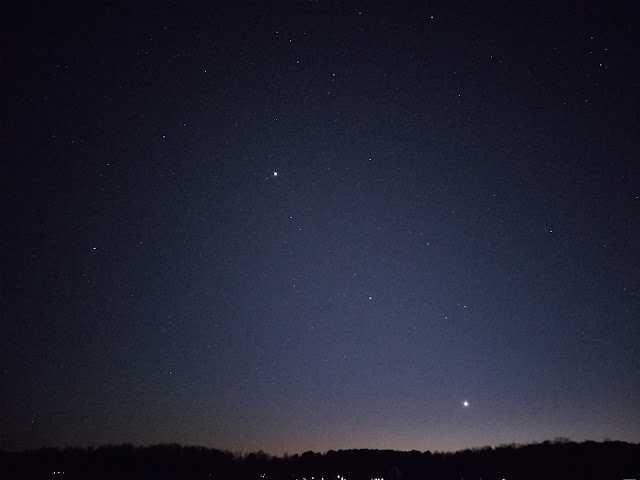
In order to escape multitudes of neighborhood lights, including Christmas lights(!), I walked to a nearby farm field and set up my camera on the bike path there. For a time it was nicely dark. Then, incredibly, a guy with a glaring bright light attached to his head walked his dog along the bike path! No sooner had he disappeared than another guy with a bright headlight came past multiple times on a bike! Eventually, however, I was able to take the following 10-second exposure with my phone.Venus, Saturn, and Jupiter, are nicely arrayed in ascending order up from the horizon on a diagonal line not far from the ecliptic. You can also see the small, kite-like constellation Delphinus in the upper right hand corner. (The ecliptic is the projection of Earth's orbital plane on the sky. Earth's orbital plane is roughly the same as the plane of all solar system planetary orbits.) The next picture, a screenshot from Stellarium, labels the planets and some other features.As you can see in the first image above, no comet is readily visible. It must have been too dim for capture by a 10-second exposure. The next picture shows an empty red circle where the comet should have appeared.It was a pretty scene, but no comet!

Thursday, December 2, 2021

Thanksgiving Hikes

November Shore

Our unusual family Thanksgiving gathering this year took place near the ocean in Corolla, NC. Although there seemed to be fewer people present at this late autumn date compared to summer, the traffic on Route 12 was still significant. Shortly after arrival at our rental house on November 24th we headed out into cold air for a hike to the beach. As we left the driveway a low altitude afternoon Sun illuminated decorative grass near the street. 

The ocean was definitely not very inviting on this cold, windy day.
Rough surf differed from typically calm summer conditions. Slogging north up the mostly deserted beach into a strong chilly headwind drained my stamina. By the time we returned home I was ready to sit in a warm house.

Before the customary Thanksgiving dinner on November 25th we took another longer hike on the nearby Pine Island Audubon Sanctuary Nature Trail. Stunted deformed trees on both sides of the trail shielded us from wind. This trail would be great for running in fall or winter, but would likely be swarming with flies in summer.

Sunlight penetrated to isolated patches on the forest floor. One sunbeam landed on a single mushroom sprouting from a clump of moss. 
A ground-hugging vine had evenly spaced alternating leaves.
We came upon an unexpected small paved airstrip running parallel to the trail. No planes, hangers, or facilities were present. While exploring the airstrip Keegan, Sophie, Ellen, and their friends climbed onto one of the tree branches for a photo. 
Further along the trail was a side path leading to a viewing stand overlooking Currituck Sound. The panoramic image below shows the scene with afternoon sun reflected from the water. (Click on the image for a larger, better view.)
Ellen searched the horizon with binoculars while the kids had fun with cattails. 
The trail continued on beyond the overlook for quite a distance. Unfortunately, my energy level was nearing empty. This seems to be happening more frequently these days. So we turned around and returned to the trailhead. Although calories were burned on the hike, I'm sure many more were consumed at Thanksgiving dinner later that day!


Wednesday, November 17, 2021

Three Sunspots

Mild November Conditions

November 10th was the final day of a rare three-day stretch of cloudless weather in Williamsburg! Just after noon soft breezes and a temperature of 71 degrees lured me outside to image the Sun. Three small sunspots were arranged in a disc-spanning triangle. A few modest prominences decorated the rim.

I screwed a ZWO 1600 camera directly to the blocking filter diagonal of my Lunt 100 mm solar telescope. The 1600 imaging chip is big enough to capture the entire solar disc at prime focus. In this prime focus configuration (with no magnifying Barlow lens) the full disc image is obtained all at once and doesn't require assembling separate panels into a mosaic. The chip is so big I could define a small portion as a region of interest large enough to include the whole Sun. The first image below shows the full disc and prominences captured by the 1600 camera. You need to enlarge the image by clicking on it in order to properly see all the details.In my experience the 1600 camera has never been good for solar imaging. The chip doesn't seem to have a uniform response over its entire surface. The effect isn't apparent in the previous image because I was able to put the Sun's image on part of the chip where the nonuniform response was minimal.

Separate images of the three sunspots were made with ZWO 174 camera and 3X Barlow lens. First, southern hemisphere sunspot 2894 featured a split umbra and accompanying curved dark filament.Next, solitary sunspot 2893 was nearly ready to rotate out of sight around the western solar limb.Finally, sunspot 2895  displayed only tiny, nearly indistinguishable umbras in the next image. 
November 10th wasn't a particularly dramatic day for solar features, but it's nice to see even modest activity after recent years of featureless Sun!


People say I'm crazy doing what I'm doing
Well they give me all kinds of warnings to save me from ruin
When I say that I'm o.k. well they look at me kind of strange
Surely you're not happy now you no longer play the game

People say I'm lazy dreaming my life away
Well they give me all kinds of advice designed to enlighten me
When I tell them that I'm doing fine watching shadows on the wall
Don't you miss the big time boy you're no longer on the ball

I'm just sitting here watching the wheels go round and round
I really love to watch them roll
No longer riding on the merry-go-round
I just had to let it go

John Lennon