Thursday, October 6, 2016

Iberian Discovery - Part 2

Lisbon and Portugal

One day after our initial unguided exploration in Lisbon we began our official tour at two historic sites in the Belem district. The fame and popularity of these landmarks attracted large tourist crowds and long entry lines.

Our first stop was the Jeronimos Monastery, also called the Hieronymites Monastery, whose construction began in 1501 and continued over the next 100 years. It was financed largely from taxes upon Portuguese trade with newly discovered lands in Africa and India. The first picture below is the South Portal to the Monastery's Church of Santa Maria. The next two pictures show details on the smaller western portal where we entered the church.
Although the church interior was impressive, it was relatively modest compared with enormous cathedrals we would later see in Spain. This church contains the tomb of Vasco da Gama as well as tombs of various Portuguese monarchs.
It was difficult to accurately capture interior church details because light varied from bright to dim in a way that confused camera settings. It was also nearly impossible to find a view not filled with gawking tourists. (Of course, we ourselves were gawking tourists in the photos of others!) Next is a 5-panel panorama showing, with slight distortion, my best attempt to capture the elaborate stone work in the monastery's cloisters. (Click on the image to see the full-sized version.) Our last stop in the monastery was in the refectory, or dining hall. Side walls were adorned with colorful azulejo tiles representing scenes from the Old Testament life of Joseph in Egypt.
After the monastery we moved on to another tourist hot spot, the Tower of Belem. This iconic building on the Tagus River was a fortification constructed between 1514-1520 to help guard the river.
The tower pictures above were purposely framed to hide the long lines waiting to enter. One advantage of being with a tour group was bypassing long lines, going as a group to the front, and gaining immediate entrance through specially prearranged group tickets. I didn't go in the tower, but C braved the crowds and took this picture from the front "porch".
About 100 meters from the Belem Tower is the Portuguese equivalent of our Vietnam Memorial. Sentries guard a monument to war dead whose names are listed on the wall behind.
There is some parallel between Portuguese deaths in the struggle to maintain their colonial hold on Angola and deaths in our Vietnam war. Apparently, protests in the early 1970's against the Angola war were great enough to topple Portugal's dictatorial ruler at the time and install the new constitutional democracy in force today.

We next visited the Museum Nacional de Arte Antiga filled with paintings and a fine collection of elaborate artifacts.
The next two pictures below are a poor attempt to capture the unbelievably intricate gold work in what is called the Belem Monstrance. According to museum information, this masterpiece was completed in 1506 by Portuguese goldsmith, Gil Vicente, on orders from King Manuel I. It was made for the Jeronimos Monastery from gold paid as tribute to Manuel I by the King of Kilwa who reigned in what is now Tanzania. The gold tribute was brought to Portugal in 1503 by Vasco da Gama! Wow! That's some amazing history!

The blue and red colored robes of the 12 apostles arranged around the monstrance bottom seemed, at first glance, to be made of gemstones, but, apparently, they are enamel. I was so captivated by this jaw dropping exhibit that I temporarily lost contact with our tour group.

Our busy day ended with a dinner cruise on the Tagus River. This beautiful Lisbon scene drifted by along the way.
Early the next day we were off to see Cabo da Roca, the western most point on continental Europe. (Yes, Ireland is further west, but it isn't continental Europe.)
The windy, rocky coast at Cabo da Roca was impressive.
Next was a stop in the town of Cascais, pronounced "k-eye-ish k-eye-ish". There are lots of "ish" sounds in Portuguese. For example, we learned Vasco da Gama is pronounced "Vashko" da Gama. Here's an amusing thing I noticed. When a door handle is labeled "puxe" in Portuguese it means "pull" in English. But "puxe" is pronounced "poosha". So, in Portuguese, "poosha" means "pull"!

Cascais is a seaside resort. This pleasant street led to a cozy beach.
Along the way to the beach C walked on an optical illusion sidewalk mosaic. In spite of appearances, this sidewalk was absolutely flat!
The Cascais beach in a protected harbor had no waves this day.
Here are three street scenes from Cascais.
Our bus took us back to Lisbon from Cascais for a late afternoon visit to the Maritime Museum located in the Jeronimos Monastery. The museum was filled with remarkably detailed ship models, antique nautical instruments, and ancient maps.
The map in the last picture, a copy of the original, dates from 1502 and shows Portuguese knowledge of Brazil, Africa, and India at the time. Also displayed at the Maritime Museum were remains of a ship carrying pepper which wrecked on September 15, 1606.
The next day we left Lisbon and drove along the southwestern coast of Portugal towards Spain. Below are two street scenes from the town of Lagos where we stopped for lunch.
During our journey through southwestern Portugal our guide entertained us with an informative talk about cork. We drove past thousands and thousands of cork trees. The following picture shows some cork trees on the distant hill, but doesn't really illustrate the widespread distribution of trees.
I'd never given much thought to cork before, but now I know where it comes from and something about how it is harvested from trees. Portugal is a major cork producer. Many Portuguese gift shops sold a surprising variety of cork items. There were cork handbags, cork hats, cork shoes, cork wallets, cork belts, cork eyeglass cases, cork key chains, cork watchbands, men's ties made of cork, and even cork umbrellas! The next picture from one of the gift shops shows the raw material - a segment of cork bark about as thick as a typical wine stopper.
Eventually, we neared Sagres at the far southwestern tip of Portugal. Our guide took us to a lovely stretch of coast featuring ocean caves and stone arches. (Click on the last panorama for a larger view.)
The temperature outside our air conditioned tour bus was close to 100 degrees! Blue water in the previous pictures looked very inviting, but there was no swimming for us. Back on the tour bus, we proceeded to a fort at Sagres Point.

Prince Henry the Navigator lived in the Sagres area. In the mid 1400's, Henry brought cartographers and experts in nautical navigation to Sagres to form an influential intellectual "school" of thought. The work of Henry and his "school" was crucial to the ultimate success of subsequent Portuguese exploratory voyages.

The Sagres fort itself was reconstructed after being destroyed by an enormous tsunami from the 1755 Lisbon earthquake. A large stone circle, visible in the picture below, was unearthed in 1919. It's uncertain exactly when the circle was constructed, but it probably had nothing to do with Prince Henry the Navigator. I walked around the circle counting segments. Taking into account two obviously missing radial lines, I counted 45 segments, so the 360 degree circle was divided into small divisions of 8 degrees.
After a long, hot day we arrived at our final hotel in Portugal. It was a lovely hotel with a nice pool and beautiful art work in the lobby. The next picture shows a wall near the hotel entrance. The stone work depicts Prince Henry the Navigator surrounded by his "school" of navigators, instrument makers, and cartographers. Prince Henry, in the center, is always pictured wearing a large hat like the one below. Our guide told us Henry probably never wore such a hat. An artist who painted Henry's portrait years after Henry's death put Henry in a hat that was fashionable at the time of the painting. Afterward, as a result of this influential artist, Henry was always portrayed in a hat he never actually wore.
Here are some views of the hotel lobby and pool.
The next morning we ate breakfast in this dining room as we prepared to leave Portugal and travel to Spain.
  

Wednesday, September 28, 2016

Iberian Discovery - Part 1

Exploring Lisbon - Day One

Our recent tour of Portugal and Spain was truly wonderful! Although neither country previously held special interest for me, I'm glad we decided to sign up for a tour. We learned so much, and saw many beautiful things while traveling through countries rich in history. Our witty, erudite guide shared his knowledge and entertained us along the way. The food and weather were outstanding. I'm so glad we took this trip!

Our tour began in Lisbon, Portugal. After checking in to our conveniently located hotel, we set off walking on our own to explore nearby parts of the city. Here's the scene on the Avenida da Liberdade at the beginning of our hike just outside the front door of the hotel. (Click on any picture for a bigger view.)
We soon passed through two attractive, sunlit squares. The first was Praca dos Restauradores, and the second was Praca Dom Pedro IV, or Rossio Square.
Along the way we passed uncountable sidewalk restaurants like these.
The linear density of restaurants per foot along our route was astounding! It seemed every other doorway was a restaurant, many with waiters urging passersby to stop.

Before long we arrived at a pedestrian street, Rua Augusta, lined on either side with shops. Down the center ran an almost unending line of shaded outdoor tables leading towards an enticing monumental arch at the far end.
Heading toward the arch, we strolled past shops like these.
Eventually, we passed under the arch leading to the Tagus River.
The arch opened to a large open square, Praca Comercio, whose immensity was difficult to capture in one photo. The view looking away from the river is shown in the first picture below. In the opposite direction was the Tagus River itself seen in the second picture.
On the green hilltop above and beyond Comercio Square in the next picture is Castelo de Sao Jorge, or Saint George's Castle, our planned destination for the afternoon.
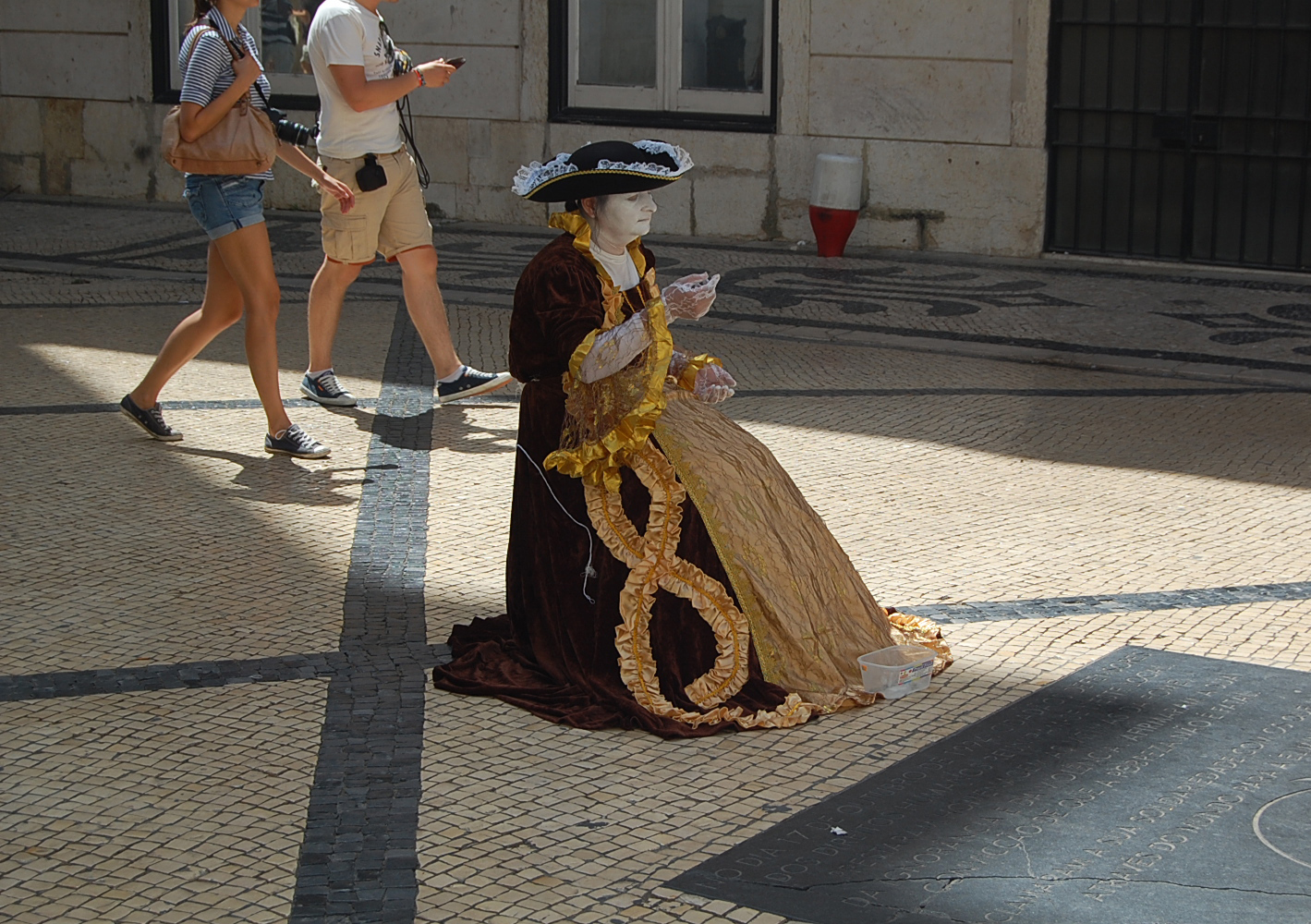
You may have noticed beautiful black and white stone pavement mosaics in many of the pictures above. These mosaics, ubiquitous in Lisbon, were characteristic of many streets, plazas, and sidewalks everywhere we went in Portugal. We learned individual mosaic stones were all installed by hand. Look at the sidewalk in the next picture, and the pavement beneath the motionless street performer in the second picture below.
A street vendor sold beautifully made examples of the mosaic patterns nearby.
The way to Castelo de Sao Jorge passed along steep twisty roads of the Alfama district. Before the trip I was anxious about getting lost in the labyrinth of narrow streets leading to the castle. Navigation turned out to be easier than expected. A few well-placed signs guided us. Heading uphill eventually brought us to the castle on top. We followed trolley tracks much of the way.
Restaurants continued appearing with incredible frequency as we climbed, although now they seemed smaller, neighborhood places rather than tourist traps. We also passed many examples of beautiful tile work.
After winding through more uphill twists and turns on streets like the one in the next picture, we finally arrived at the castle.
The castle hilltop has a long history. First fortified by Romans in about 48 BCE, it was more strongly fortified in the 10th century by Muslim Berbers. The "Moors" were defeated in 1147, and, for many years after, Portuguese kings resided in the castle. When Vasco da Gama returned from discovering the route to India in 1499, he was received by King Manuel I at Castelo de Sao Jorge.

We spent time exploring the castle grounds.
The plaza in front of the castle offered beautiful views of the city below.
Leaving the castle, we headed downhill again, and, after a few errant turns, returned, a bit weary, to our blue-sided hotel shown in the next picture.
It was an exhilarating afternoon. We felt good about ignoring jet lag and seeing so much independently during our first day. The next day we would explore more of Lisbon with the tour group and our guide.     

People say I'm crazy doing what I'm doing
Well they give me all kinds of warnings to save me from ruin
When I say that I'm o.k. well they look at me kind of strange
Surely you're not happy now you no longer play the game

People say I'm lazy dreaming my life away
Well they give me all kinds of advice designed to enlighten me
When I tell them that I'm doing fine watching shadows on the wall
Don't you miss the big time boy you're no longer on the ball

I'm just sitting here watching the wheels go round and round
I really love to watch them roll
No longer riding on the merry-go-round
I just had to let it go

John Lennon