My Biggest Scope!
I enjoyed using a Dobsonian telescope recently in Australia so I decided to get one for myself. The relative design simplicity and easy setup appealed to me. The Dobsonian requires no electric power, no computer, and no tedious initial mount alignment. I can leave it outside an hour or two before dark to let the mirror reach ambient temperature, and later begin observing immediately. Sometimes, I just don't have the energy for the relatively complicated setup of my computer controlled, equatorially mounted 130 mm refractor even though the refractor eventually finds objects automatically and is capable of guided photography. The Dobsonian isn't much good for getting images, but it's fine for visual observing.
I purchased the new scope from Orion Telescope. It has a 12-inch (305mm) diameter mirror with a 1500mm focal length. It came with two Plossl eyepieces, a 2X Barlow lens, and a 9X50 right angle finderscope. The assembled telescope is pictured below.
Dobsonian telescopes use the basic Newtonian design. Looking down the tube you can see the large primary mirror at the base and the smaller secondary mirror suspended near the top of the tube.
Light enters the open telescope tube, reflects from the curved primary mirror, and converges toward focus on its way back up the tube. The converging light then reflects from the smaller 45-degree tilted secondary mirror and heads toward the side into the focusing tube where an eyepiece magnifies the final image for viewing. The next picture shows the secondary mirror supported by four thin vanes.
Light eventually exits the side of the tube and is viewed through the eyepiece there.
To help aim the telescope at desired targets a small finderscope with relatively large field of view is mounted on the tube. The finderscope is aligned parallel to the large scope's optic axis, so, when everything is properly set up, an observer can first place a target in the finderscope's crosshairs and subsequently find the same target centered in the main telescope's eyepiece. Unfortunately, I found the included right angle finderscope completely useless. I'm used to straight-through finders where I look with one eye at the sky while the other eye looks through the finder eyepiece. I found it almost impossible to comfortably sight a star and get that star in the right angle finder eyepiece. Maybe this was caused by my own lack of experience with right angle finders, but the right angle finder was awful! So I dismounted the right angle finder and installed a more powerful 13X80 straight-through finder from my refractor. This didn't eliminate my difficulties because this larger finder's eyepiece position was very uncomfortable. The wide finder body also blocked simultaneous sky viewing using both eyes.
Based on conversations with an expert Dobsonian observer during our Australia trip I decided to purchase a Telrad finder. The Telrad is the rectangular box-like object attached to the tube in the center of the next picture.
The Telrad finder doesn't provide magnification or light gathering power like a traditional finderscope. Instead, the observer views the sky through a tilted piece of glass. The tilted glass is transparent enough to allow starlight through. It simultaneously reflects light from a set of illuminated concentric red circles toward the eye. The observer sees dimly glowing red circles superimposed on a view of the sky. When aligned properly, the observer puts a target object in the center circle and finds the telescope pointing at that same object. The next picture shows a view of the first quarter Moon through the Telrad. My phone camera focused on the nearby Telrad body instead of the distant Moon. This made the Moon and illuminated circles out of focus in the image below. To my eye, however, the first quarter Moon and red circles were clearly in sharp focus.
With the Telrad finder I now have a practical, efficient way of aiming the telescope.
The telescope arrived in several boxes and required assembly. I was surprised to find the big mirror needed to be installed in the tube. Mirror installation made me a little nervous, especially while holding the heavy mirror hovering over the tube almost 6 feet above the floor! It took some time to put everything together, but the included instructions were easy to follow. After constructing the telescope it was time to properly align the mirrors.
I had never performed telescope collimation before, so I consulted several helpful videos and written articles. Two collimation methods were available. The first method involved looking through a small hole centered in the eyepiece holder. The view of multiple mirror reflections seen through the small hole didn't exactly match any of the instructional illustrations available. I was confused and unsure what to do about this. Nevertheless, I carried out the first collimation procedure to the best of my ability. Fortunately, the second collimation method was simpler to understand. The second method involved placing a small laser in the eyepiece position. The secondary mirror was adjusted so the laser beam hit the center of the primary mirror. Then the primary mirror itself was adjusted so the reflected laser beam was centered in the laser "eyepiece". I carried out the laser procedure very carefully and then performed an alignment confirmation check by taking the laser out and looking through the small eyepiece hole from the first collimation procedure. I was puzzled to discover the two collimation procedures produced incompatible results! Alignment by laser caused misalignment through the small viewing hole and vice versa! Consequently, I had no confidence the telescope was properly collimated by either method.
The imprecise collimation procedures were disappointing. For
example, the laser beam changed direction with the slightest tightening
or loosening of the eyepiece holder. The laser beam also changed
direction when the telescope was moved from horizontal to vertical. In spite of confusing collimation results my first view of stars through the telescope was fine. Stars came to sharp focus and the Moon looked great. Apparently, if the optics are close to perfect alignment the telescope works very well.
I took a chance ordering the 12-inch telescope because it might have been too heavy to easily move. The tube weighs about 50 pounds. I can lift the tube, but find it hard to handle. It's awkward to grip, lift, or carry for any distance by hand. I use a hand truck to move the tube to my observing position. Through experience I'm getting better at lifting and placing the tube on the mount. The mount itself is easier to carry. It weighs about 34 pounds, has a handle, and includes additional places to grip.
I did discover one issue with the mount, however. The bottom triangular base which rests on the ground is attached to the circular upper base by only one central shaft. While carrying the mount the two base pieces wobble around quite a bit causing their connection to loosen. This ends up affecting the operation of the azimuth encoder. (More about this shortly.) I fixed this problem by using three c-clamps to hold the two base parts firmly together during transportation. Once the mount is in place I remove the clamps so it will be free to turn in azimuth. You can see two of the c-clamps on the base in the picture below.
The telescope comes with encoders and an electronic pointing system called IntelliScope. IntelliScope should be able to accurately point the telescope at dim objects not visible in the Telrad finder. The system requires a relatively simple three step initialization. First, the tube is pointed vertically to the zenith. Second, the telescope is pointed to a bright star. Finally, the telescope is pointed at a second bright star more than 60 degrees away from the first star. After all three pieces of information are entered into the handheld Computerized Object Locator, the telescope should, in theory, point to any object selected on the generous hand controller menu.
How well does IntelliScope work in practice? The first time I used it the system worked pretty well, but I didn't have time to test the pointing accuracy on more than a couple objects. Targeted objects were not exactly centered in the eyepiece, but they were close enough to be found and easily centered in low power eyepieces. The second and third time I used IntelliScope the system malfunctioned and didn't work at all. During these malfunctions the altitude encoder seemed to be working properly but the azimuth encoder at the bottom of the base wasn't recording telescope movement. I suspected the azimuth encoder was knocked out of proper alignment by loose, wobbling bottom base parts while moving the mount. So I carefully reinstalled the connection between the base parts and added the c-clamps mentioned previously to keep the base from wobbling during transport. The c-clamps seem to have solved the problem because Intelliscope worked reasonably well during my last observing session. For example, after performing initial alignment I entered the Andromeda Galaxy, M31, into the hand controller as a target. When I moved the telescope to the position indicated by the hand controller the galaxy was not in the field of view but slightly off to the side. I was able to find it not far from the field of view with small searching movements. Once again, I didn't have time to look for numerous target objects. In the future I'd like to explore the pointing accuracy more thoroughly.
So how good is the view through the eyepiece? The Orion Nebula was, of course, spectacular! Open star clusters look very nice. The Ring Nebula was good at 150X. The sky from my suburban back yard is not truly dark, but I could see the Crab Nebula and M78. During my last observing session on February 2nd I could see comet c/2017 T2 PANSTARRS near the Double Cluster in Perseus even with a first quarter Moon brightening the sky.
At my observing site it's a constant battle against light from neighboring houses. Neighbors turn on back yard flood lights to let their dogs out. Each one shines like a searchlight right on my telescope. When one light goes off, another comes on. It's very discouraging. Occasionally, I get lucky and all the lights are off.
Just for fun on February 2nd I decided to attach my phone camera in front of the eyepiece with a Celestron NexYZ universal smartphone adaptor. The following pictures were all taken with a Samsung Galaxy 8 Plus phone through a 25mm eyepiece. Exposures needed to be brief since Earth is turning and the mount is not tracking this rotation. The next cropped image shows the Moon in a 1/200 second exposure. Focus quality varies from place to place, and the limb has a hazy glow along its length. Focus was best near center of the camera's field of view near the middle of the terminator. The image isn't so bad considering all the layers of glass and possibilities for misalignment.
A tracking system is really needed to take images of stars and nebulae. Once again, just for the fun, I tried imaging the Orion Nebula. A 1/4 second exposure revealed some nebulosity and the four bright stars of the Trapezium in the center of the nebula. Stars didn't trail too badly during the 1/4 second. (Click on the images for a larger view.)
Increasing exposure time to one second showed more nebulosity, but, unfortunately, star images are now elongated due to Earth's rotation.
A two second exposure shows even more nebulosity and hints of color, but the stars and nebula are trailing badly.
A lower power eyepiece and target closer to the celestial pole would minimize trailing and allow longer exposures, but, really, an unguided Dobsonian telescope is not made for imaging. I look forward to more visual observing on mild spring nights in the future.
Sunday, February 9, 2020
Thursday, November 21, 2019
Transit of Mercury
Clouds Limit Observation
Mercury passed in front of the Sun on November 11th. It was probably the last transit I'll observe in my lifetime. There will be Mercury transits in 2032 and 2039, but these will not be visible from Virginia. The next transit visible from Virginia will be on May 7, 2049.
I got up early to have all my equipment ready when the transit was predicted to start at 7:35 am. The temperature near sunrise was about 47 degrees, and there was no wind. Unfortunately, the sky was nearly covered by a combination of contrails and thin clouds as you can see in the satellite picture below. My observing location is marked with a small red dot.
Clouds weren't thick enough to entirely block the Sun, but they made imaging difficult. In spite of my best efforts I missed the moment of ingress. By the time I was ready to capture images, it was 7:40 am. No matter, the seeing was absolutely terrible. Although Mercury's black disc was visible near the solar limb on my laptop monitor, its warped, contorting shape was swimming around. The limb looked like a waving rope. No amount of image processing would remove these blurry distortions.
Atmospheric steadiness increased gradually as morning progressed. I continued capturing video clips hoping one of them would catch a few cloud free moments. At 9:05 am I recorded a cloudless 400 video frames over 44 seconds. After stacking the 40 best frames and further processing, the following image emerged as my only decent picture. Mercury is a well-defined black dot on the right with an apparent angular diameter of about 10 arc seconds.
The featureless solar disc had no sunspots or filaments. Therefore, Mercury always appeared against a nearly homogeneous background of disc spicules. Other Mercury images I captured were flawed in some way and not worth display.
Only one other image from this day was worthwhile. A small eruption was visible on the southeastern solar limb. The next picture shows the outburst. There are also three barely visible vertical bands in the image that remain after a flawed flat field calibration.
The eruption above was associated with a small, newly emerged sunspot which rotated into view in the next couple of days. This quickly dying sunspot was a member of the next solar cycle which will slowly begin producing more sunspots in coming years.
Clouds can be so frustrating! The sky was completely clear all day on the day before the transit, and the sky unexpectedly cleared almost immediately after the transit ended! During the transit itself, however, bad luck!
Mercury passed in front of the Sun on November 11th. It was probably the last transit I'll observe in my lifetime. There will be Mercury transits in 2032 and 2039, but these will not be visible from Virginia. The next transit visible from Virginia will be on May 7, 2049.
I got up early to have all my equipment ready when the transit was predicted to start at 7:35 am. The temperature near sunrise was about 47 degrees, and there was no wind. Unfortunately, the sky was nearly covered by a combination of contrails and thin clouds as you can see in the satellite picture below. My observing location is marked with a small red dot.
Clouds weren't thick enough to entirely block the Sun, but they made imaging difficult. In spite of my best efforts I missed the moment of ingress. By the time I was ready to capture images, it was 7:40 am. No matter, the seeing was absolutely terrible. Although Mercury's black disc was visible near the solar limb on my laptop monitor, its warped, contorting shape was swimming around. The limb looked like a waving rope. No amount of image processing would remove these blurry distortions.
Atmospheric steadiness increased gradually as morning progressed. I continued capturing video clips hoping one of them would catch a few cloud free moments. At 9:05 am I recorded a cloudless 400 video frames over 44 seconds. After stacking the 40 best frames and further processing, the following image emerged as my only decent picture. Mercury is a well-defined black dot on the right with an apparent angular diameter of about 10 arc seconds.
The featureless solar disc had no sunspots or filaments. Therefore, Mercury always appeared against a nearly homogeneous background of disc spicules. Other Mercury images I captured were flawed in some way and not worth display.
Only one other image from this day was worthwhile. A small eruption was visible on the southeastern solar limb. The next picture shows the outburst. There are also three barely visible vertical bands in the image that remain after a flawed flat field calibration.
The eruption above was associated with a small, newly emerged sunspot which rotated into view in the next couple of days. This quickly dying sunspot was a member of the next solar cycle which will slowly begin producing more sunspots in coming years.
Clouds can be so frustrating! The sky was completely clear all day on the day before the transit, and the sky unexpectedly cleared almost immediately after the transit ended! During the transit itself, however, bad luck!
Sunday, November 17, 2019
Australia - Part 9
Canberra
We left Parkes after breakfast and began a journey toward Canberra. Only two days remained in our Australia tour. Sinus and bronchial congestion continued to plague me along with intermittent coughing and fatigue.
Our first stop was an interesting fossil fish museum in Canowindra. The fossils were from Late Devonian times, more than 360 million years ago. According to museum posters, the fossils all come from one layer of rock first discovered in 1956 during road construction. Apparently, a large pool of water dried up killing the fishes. Many of them were placoderms, or armored fishes.
Fossils were jumbled together. Adjacent posters identified the species present. The next set of images show some of the rock slabs and their accompanying informative posters. If you click on the posters to enlarge them, they will be easier to read.
The next display speculated about the cause of the fossils' appearance.
This next slab had a well preserved rear section with tail fins clearly visible.
I purchased two agate slices in the museum shop to add to my rock collection. Then we boarded our bus and continued toward Canberra. My energy level continued dropping. I wanted to sleep.
Eventually, we stopped at a winery for a large lunch. After eating, C went to a wine tasting while I walked, coughing, slowly around the grounds in nice, sunny, spring weather. I was amused to see kids tossing a rugby ball between them and carrying cricket bats. Slow walking in warm sunshine made me drowsy. I came upon this extremely nasty tree with hard, spiky, thorn-like leaves on every surface.
After lunch we drove on and finally arrived in Canberra, Australia's capital city, where it was cold and windy. Before going to our hotel we had a brief bus tour of parks, embassies, and government buildings. Our evening was free to roam and find dinner on our own. Normally, I would have been eager to walk around and explore the city near our hotel, but I had no energy. C went walking alone. She found most places closed for a national holiday. I skipped dinner in the evening, eating only some cheez-its and cookies. I went to bed early and slept 10 to 11 hours. I really needed it.
In the morning I felt a little better, but wasn't sure how long I would last in the coming day. Another wonderful hotel breakfast buffet helped perk me up. Our first stop after breakfast was the Australian National Museum. A dinosaur named Muttaburrasaurus was mounted in the museum lobby. It lived in Australia 100 to 110 million years ago. The fossilized bones were discovered in 1963.
The museum had many excellent exhibits explaining disastrous consequences of invasive species in Australia. I also enjoyed the astounding video of an amazing, clunky, heavy jeep used to capture water buffalo. The driver, looking like Crocodile Dundee, would drive the jeep next to a running buffalo. Then a big mechanical claw could reach out from the side of the jeep and wrap around the buffalo's neck.
Examples of beautifully preserved antique scientific equipment were also on display. The next picture shows a 6-inch refractor from the 1880's once used in Australia by someone named W.J. Macdonnell. He paid 250 pounds for it at the time. According to the museum label, this is equivalent to about $30,000 today.
After our time in the National Museum we drove about 25 miles southwest to the Canberra Deep Space Complex. This collection of radio dishes is one member of NASA's Deep Space Network which communicates with interplanetary spacecraft. The three network members are spread around the world at locations roughly 120 longitude degrees apart. In addition to the Canberra Complex, another is located in Spain about 37 miles west of Madrid at Robledo de Chavela, and another, the Goldstone Complex, is located about 45 miles northeast of Barstow, California, USA. These radio dishes receive signals from Voyager 1, the Mars Curiosity Rover, and the Juno Jupiter mission, among others.
After a security check at the entrance we drove to one end of the complex to see this panoramic view. (Click on the panorama to get a better, larger view.)
Directly behind us at the site shown in the previous panorama was this dish.
We next stopped at an old, non-operating historical dish once used to transmit data from the Apollo 11 moon mission. All the while it was cold, windy, and spitting rain. I was coughing, weak, and sleepy, so I stayed on bus while the rest of the group braved the weather outside to hear a talk about the historic dish. We then moved on to visit the control room where signals from active spacecraft were being received in real time.
We passed this beautiful large dish silhouetted against dark clouds on the way back to our bus after the tour.
We left the Canberra Deep Space Complex and drove back toward Canberra with a stop at Mount Stromlo Observatory on the way. A group of large kangaroos watched us pass on the drive up the mountain road. Once again, it was impossible to get photos from the moving bus.
Brutal, cold, windy, weather greeted us at the mountaintop along with pelting rain. Although Mount Stromlo Observatory was largely ruined by a wildfire in 2003, some modern domes still exist there.
This large dome was full of junk and apparently unused.
Ruined, rusting equipment lay around.
The next image shows one of the ruined domes.
I was glad to return to the warm bus after my brief picture taking expedition outside.
We then drove back to our Canberra hotel. In the evening our tour group shared a final dinner at a local restaurant. Once again, it was hard for me to hear conversation in the noisy room. We would all be going our separate ways the next day, so there were many farewells.
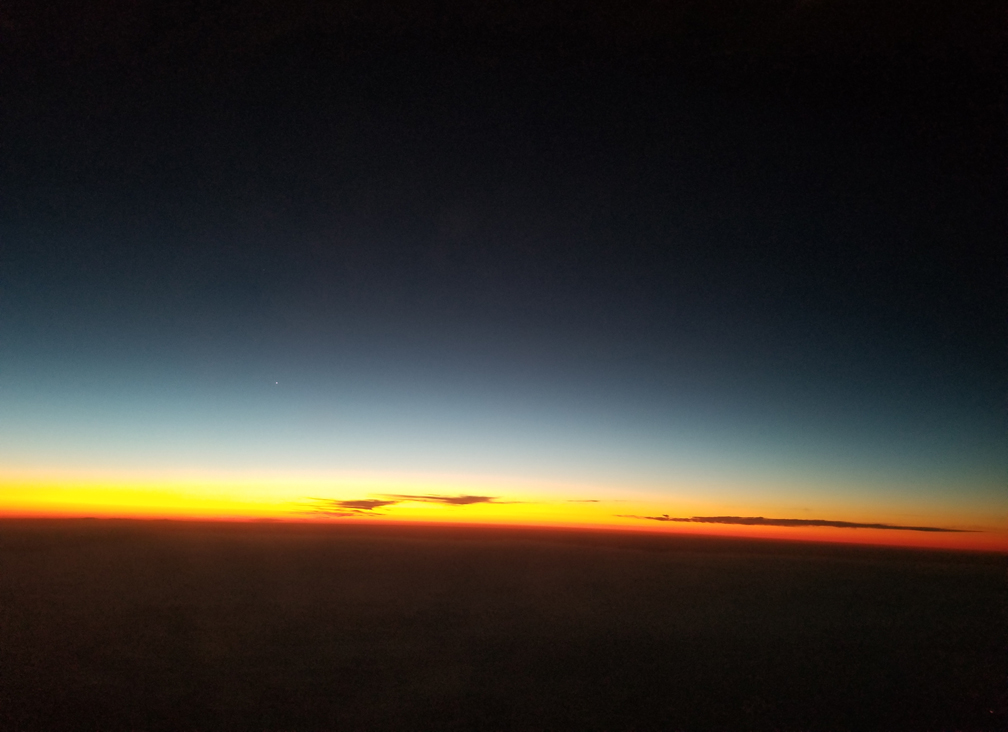
Next morning we had our last magnificent hotel breakfast buffet and boarded a bus for the long 4-hour drive to Sydney airport where the usual airport/airplane madness began. I had a westward facing window seat on the first flight from Sydney to Brisbane and was able to capture some nice sunset pictures over a span of 28 minutes. The next 6 images show sunset and the gradual appearance of Venus and Mercury as twilight deepened. Venus is brighter and closer to the horizon. Mercury is dimmer and above Venus.
When finally seated on our second flight from Brisbane to Los Angeles it had been 12 hours since we left the hotel in Canberra. Now we flew over the Pacific to Los Angeles. As wheels touched down in LA 24 hours and 50 minutes had elapsed since leaving Canberra. A long 8-hour layover was endured in LA. Then, after 32 hours of elapsed travel time, we lifted off from LA on our third flight to Philadelphia. Five hours later we arrived in Philadelphia with one last flight remaining. A mercifully short fourth flight then took us to the Newport News Airport and final release from airport hell. By the time we drove home we had been traveling for 41 hours since leaving Canberra!
My desire to see the southern sky on this trip was only partially satisfied. On the plus side, I identified eight new constellations by direct sight overhead and found even more indirectly later in images I captured. I also saw nine new celestial objects, three of these through telescopes. But there was so much more unseen! My biggest disappointment was inability to see the Milky Way high overhead in a dark sky. Clouds were partly to blame. We had some rotten luck with clouds. The tour was scheduled during a waxing Moon which added its increasing glare as the days passed. The glaring Moon was also unfortunately located in the middle of the brightest central portion of the Milky Way.
Now we are back in Virginia with familiar trees, birds, insects, animals, constellations, and driving customs. Our visit to Australia was wonderful and full of new unforgettable experiences! It was a privilege to see the different world in Australia!
We left Parkes after breakfast and began a journey toward Canberra. Only two days remained in our Australia tour. Sinus and bronchial congestion continued to plague me along with intermittent coughing and fatigue.
Our first stop was an interesting fossil fish museum in Canowindra. The fossils were from Late Devonian times, more than 360 million years ago. According to museum posters, the fossils all come from one layer of rock first discovered in 1956 during road construction. Apparently, a large pool of water dried up killing the fishes. Many of them were placoderms, or armored fishes.
Fossils were jumbled together. Adjacent posters identified the species present. The next set of images show some of the rock slabs and their accompanying informative posters. If you click on the posters to enlarge them, they will be easier to read.
The next display speculated about the cause of the fossils' appearance.
This next slab had a well preserved rear section with tail fins clearly visible.
I purchased two agate slices in the museum shop to add to my rock collection. Then we boarded our bus and continued toward Canberra. My energy level continued dropping. I wanted to sleep.
Eventually, we stopped at a winery for a large lunch. After eating, C went to a wine tasting while I walked, coughing, slowly around the grounds in nice, sunny, spring weather. I was amused to see kids tossing a rugby ball between them and carrying cricket bats. Slow walking in warm sunshine made me drowsy. I came upon this extremely nasty tree with hard, spiky, thorn-like leaves on every surface.
After lunch we drove on and finally arrived in Canberra, Australia's capital city, where it was cold and windy. Before going to our hotel we had a brief bus tour of parks, embassies, and government buildings. Our evening was free to roam and find dinner on our own. Normally, I would have been eager to walk around and explore the city near our hotel, but I had no energy. C went walking alone. She found most places closed for a national holiday. I skipped dinner in the evening, eating only some cheez-its and cookies. I went to bed early and slept 10 to 11 hours. I really needed it.
In the morning I felt a little better, but wasn't sure how long I would last in the coming day. Another wonderful hotel breakfast buffet helped perk me up. Our first stop after breakfast was the Australian National Museum. A dinosaur named Muttaburrasaurus was mounted in the museum lobby. It lived in Australia 100 to 110 million years ago. The fossilized bones were discovered in 1963.
The museum had many excellent exhibits explaining disastrous consequences of invasive species in Australia. I also enjoyed the astounding video of an amazing, clunky, heavy jeep used to capture water buffalo. The driver, looking like Crocodile Dundee, would drive the jeep next to a running buffalo. Then a big mechanical claw could reach out from the side of the jeep and wrap around the buffalo's neck.
Examples of beautifully preserved antique scientific equipment were also on display. The next picture shows a 6-inch refractor from the 1880's once used in Australia by someone named W.J. Macdonnell. He paid 250 pounds for it at the time. According to the museum label, this is equivalent to about $30,000 today.
After our time in the National Museum we drove about 25 miles southwest to the Canberra Deep Space Complex. This collection of radio dishes is one member of NASA's Deep Space Network which communicates with interplanetary spacecraft. The three network members are spread around the world at locations roughly 120 longitude degrees apart. In addition to the Canberra Complex, another is located in Spain about 37 miles west of Madrid at Robledo de Chavela, and another, the Goldstone Complex, is located about 45 miles northeast of Barstow, California, USA. These radio dishes receive signals from Voyager 1, the Mars Curiosity Rover, and the Juno Jupiter mission, among others.
After a security check at the entrance we drove to one end of the complex to see this panoramic view. (Click on the panorama to get a better, larger view.)
Directly behind us at the site shown in the previous panorama was this dish.
We next stopped at an old, non-operating historical dish once used to transmit data from the Apollo 11 moon mission. All the while it was cold, windy, and spitting rain. I was coughing, weak, and sleepy, so I stayed on bus while the rest of the group braved the weather outside to hear a talk about the historic dish. We then moved on to visit the control room where signals from active spacecraft were being received in real time.
We passed this beautiful large dish silhouetted against dark clouds on the way back to our bus after the tour.
We left the Canberra Deep Space Complex and drove back toward Canberra with a stop at Mount Stromlo Observatory on the way. A group of large kangaroos watched us pass on the drive up the mountain road. Once again, it was impossible to get photos from the moving bus.
Brutal, cold, windy, weather greeted us at the mountaintop along with pelting rain. Although Mount Stromlo Observatory was largely ruined by a wildfire in 2003, some modern domes still exist there.
This large dome was full of junk and apparently unused.
Ruined, rusting equipment lay around.
The next image shows one of the ruined domes.
I was glad to return to the warm bus after my brief picture taking expedition outside.
We then drove back to our Canberra hotel. In the evening our tour group shared a final dinner at a local restaurant. Once again, it was hard for me to hear conversation in the noisy room. We would all be going our separate ways the next day, so there were many farewells.
Next morning we had our last magnificent hotel breakfast buffet and boarded a bus for the long 4-hour drive to Sydney airport where the usual airport/airplane madness began. I had a westward facing window seat on the first flight from Sydney to Brisbane and was able to capture some nice sunset pictures over a span of 28 minutes. The next 6 images show sunset and the gradual appearance of Venus and Mercury as twilight deepened. Venus is brighter and closer to the horizon. Mercury is dimmer and above Venus.
When finally seated on our second flight from Brisbane to Los Angeles it had been 12 hours since we left the hotel in Canberra. Now we flew over the Pacific to Los Angeles. As wheels touched down in LA 24 hours and 50 minutes had elapsed since leaving Canberra. A long 8-hour layover was endured in LA. Then, after 32 hours of elapsed travel time, we lifted off from LA on our third flight to Philadelphia. Five hours later we arrived in Philadelphia with one last flight remaining. A mercifully short fourth flight then took us to the Newport News Airport and final release from airport hell. By the time we drove home we had been traveling for 41 hours since leaving Canberra!
My desire to see the southern sky on this trip was only partially satisfied. On the plus side, I identified eight new constellations by direct sight overhead and found even more indirectly later in images I captured. I also saw nine new celestial objects, three of these through telescopes. But there was so much more unseen! My biggest disappointment was inability to see the Milky Way high overhead in a dark sky. Clouds were partly to blame. We had some rotten luck with clouds. The tour was scheduled during a waxing Moon which added its increasing glare as the days passed. The glaring Moon was also unfortunately located in the middle of the brightest central portion of the Milky Way.
Now we are back in Virginia with familiar trees, birds, insects, animals, constellations, and driving customs. Our visit to Australia was wonderful and full of new unforgettable experiences! It was a privilege to see the different world in Australia!
Wednesday, November 13, 2019
Australia - Part 8
Emus and Parkes
There was one last chance to see dark sky during our last overnight stay at Siding Spring Observatory. I got up after the Moon had set at 3:15 am to view the predawn sky without interfering moonlight. Feeling somewhat like an intruder creeping around alone after midnight, I once again took the 10-inch Dobsonian telescope from its storage place and set it up outside on the dirt area below the Anglo-Australian Telescope Dome. I took a look at the telescope's mirror and was appalled to find it mostly covered with dirty deposits! Much to my surprise, the telescope gave very nice views in spite of the grungy mirror appearance. I had managed to obtain the telescope's finderscope, and, with finderscope properly attached, the telescope was properly balanced. Its operation was greatly improved.
Although the Moon had set, and clear sky was very dark, unfortunate clouds covered half the sky. A good-sized patch of clear sky remained only in the southeast, so I pointed the telescope there and explored. I was absolutely thrilled to see the Eta Carinae Nebula and other unidentified star clusters in its vicinity. The v-shaped dark lane through the nebula was clearly obvious.
I should have been better prepared with star maps and lists of objects to observe instead of pointing the telescope randomly around. The water tower next to the Anglo-Australian Telescope Dome was partially blocking the view of clear sky. Unfortunately, there wasn't enough time to move the telescope or look at more star clusters because clouds moved to cover the entire sky! I gave up and returned the telescope at 5:00 am. Based on my experience using this Dobsonian telescope I'm tempted to buy one for myself.
By the time I got back to our room there really wasn't time to sleep. We packed bags and had breakfast. Before leaving Siding Spring we had one final tour of an old Schmidt telescope led by our expert astronomical guide, Fred Watson. Fred showed us how things were done in the days before digital imaging. Images were made on glass plates and developed in a dark room.
Descending the mountain from Siding Spring we drove through very dry country to an emu farm. These big birds are second in size only to ostriches. Check out the egg sizes seen in this display in the emu farm visitor center.
Why would there be such a thing as an emu farm? Apparently, emu oil, derived from the bird's fat, is a useful product. Some questions and answers about emus were written on the side of a cabinet. (Click on the image to enlarge it and make it easier to read.)

The emus were inexplicably fond of dried out leaves offered as food. C enjoyed feeding the birds as they pecked vigorously.
We stood very close to these enormous birds and were invited to enter the enclosure to stand among the jostling beasts. The birds were really big, pushy, pecking, and so alien that neither of us had the courage to go in. A farm employee would grab a particularly pushy bird by the neck to move it away - something I doubt I would be prepared to do!
After leaving the emu farm we drove through parched country to the town of Parkes. The whole surrounding area was experiencing a historically prolonged drought. When we arrived at our motel in Parkes I was completely exhausted and wanted nothing more than to get some sleep. Sleep was impossible because we were soon leaving for a drive to the Parkes Radio Telescope. As we boarded the bus a blowing dust storm turned the sky orange.
The Parkes Radio Telescope is famous for its role in the Apollo 11 moon landing. The historic video of Neil Armstrong's first step on the Moon was transmitted first through the Parkes radio dish and then out around the world. The dish is also a functioning research instrument for radio astronomy.
As we walked outside toward our scheduled tour of the dish we were again assaulted by relentless flies. The tour was led by an enthusiastic expert guide who was knowledgeable and articulate. He gave wonderful explanations of the extremely precise radio astronomy work done here. Hard hats were required to enter the area around the dish. Our group was ready to go in the picture below.
During the tour we stood in the control room where radio pulses from a pulsar were being received in real time as we watched!
After the dish tour we walked back to the visitor center for dinner. A big flock of galah cockatoos flew around the site and landed on a lawn near us. Other colorful green and red parrots also grazed on the lawn, but it was impossible to get pictures.
Indian food was served for dinner. It was mostly too spicy for me, so I passed along bowls and only nibbled some rice and bread. After dinner a well meant but embarrassing surprise birthday celebration was held for me. The embarrassment was worth it because I was able to eat an enormous piece of cake to make up for not eating much dinner. By the time dinner was over the Sun had set.
The dust filled sky had cleared somewhat after dinner although it was still hazy. An 8-inch Dobsonian telescope was brought outside into the light polluted area near the visitor center. Eventually, the telescope was set up in working order. I could see Crux, the Southern Cross, still visible above the horizon, so I requested a look at the Jewel Box star cluster. There it was! I was thrilled to see this colorful sprinkling of stars for the first time! I also saw globular cluster 47 Tucanae once more. This was another time when I wish I was better prepared with a list of possible viewing targets. In particular, I wish I had a few double stars to suggest because they show up well even when sky conditions aren't ideal. Glaring lights were impossible to avoid, however. It was getting late, so we had to leave and return to our motel.
There was one last chance to see dark sky during our last overnight stay at Siding Spring Observatory. I got up after the Moon had set at 3:15 am to view the predawn sky without interfering moonlight. Feeling somewhat like an intruder creeping around alone after midnight, I once again took the 10-inch Dobsonian telescope from its storage place and set it up outside on the dirt area below the Anglo-Australian Telescope Dome. I took a look at the telescope's mirror and was appalled to find it mostly covered with dirty deposits! Much to my surprise, the telescope gave very nice views in spite of the grungy mirror appearance. I had managed to obtain the telescope's finderscope, and, with finderscope properly attached, the telescope was properly balanced. Its operation was greatly improved.
Although the Moon had set, and clear sky was very dark, unfortunate clouds covered half the sky. A good-sized patch of clear sky remained only in the southeast, so I pointed the telescope there and explored. I was absolutely thrilled to see the Eta Carinae Nebula and other unidentified star clusters in its vicinity. The v-shaped dark lane through the nebula was clearly obvious.
I should have been better prepared with star maps and lists of objects to observe instead of pointing the telescope randomly around. The water tower next to the Anglo-Australian Telescope Dome was partially blocking the view of clear sky. Unfortunately, there wasn't enough time to move the telescope or look at more star clusters because clouds moved to cover the entire sky! I gave up and returned the telescope at 5:00 am. Based on my experience using this Dobsonian telescope I'm tempted to buy one for myself.
By the time I got back to our room there really wasn't time to sleep. We packed bags and had breakfast. Before leaving Siding Spring we had one final tour of an old Schmidt telescope led by our expert astronomical guide, Fred Watson. Fred showed us how things were done in the days before digital imaging. Images were made on glass plates and developed in a dark room.
Descending the mountain from Siding Spring we drove through very dry country to an emu farm. These big birds are second in size only to ostriches. Check out the egg sizes seen in this display in the emu farm visitor center.
Why would there be such a thing as an emu farm? Apparently, emu oil, derived from the bird's fat, is a useful product. Some questions and answers about emus were written on the side of a cabinet. (Click on the image to enlarge it and make it easier to read.)
Outside the visitor center relentless, annoying small flies attacked from all angles once again. People walked around waving a hand in front of their face to clear the flies. We learned this hand waving is called "the Australian salute"! Several fenced areas held emus at different stages of growth from hatchlings to adults.

The emus were inexplicably fond of dried out leaves offered as food. C enjoyed feeding the birds as they pecked vigorously.
We stood very close to these enormous birds and were invited to enter the enclosure to stand among the jostling beasts. The birds were really big, pushy, pecking, and so alien that neither of us had the courage to go in. A farm employee would grab a particularly pushy bird by the neck to move it away - something I doubt I would be prepared to do!
After leaving the emu farm we drove through parched country to the town of Parkes. The whole surrounding area was experiencing a historically prolonged drought. When we arrived at our motel in Parkes I was completely exhausted and wanted nothing more than to get some sleep. Sleep was impossible because we were soon leaving for a drive to the Parkes Radio Telescope. As we boarded the bus a blowing dust storm turned the sky orange.
The Parkes Radio Telescope is famous for its role in the Apollo 11 moon landing. The historic video of Neil Armstrong's first step on the Moon was transmitted first through the Parkes radio dish and then out around the world. The dish is also a functioning research instrument for radio astronomy.
As we walked outside toward our scheduled tour of the dish we were again assaulted by relentless flies. The tour was led by an enthusiastic expert guide who was knowledgeable and articulate. He gave wonderful explanations of the extremely precise radio astronomy work done here. Hard hats were required to enter the area around the dish. Our group was ready to go in the picture below.
During the tour we stood in the control room where radio pulses from a pulsar were being received in real time as we watched!
After the dish tour we walked back to the visitor center for dinner. A big flock of galah cockatoos flew around the site and landed on a lawn near us. Other colorful green and red parrots also grazed on the lawn, but it was impossible to get pictures.
Indian food was served for dinner. It was mostly too spicy for me, so I passed along bowls and only nibbled some rice and bread. After dinner a well meant but embarrassing surprise birthday celebration was held for me. The embarrassment was worth it because I was able to eat an enormous piece of cake to make up for not eating much dinner. By the time dinner was over the Sun had set.
The dust filled sky had cleared somewhat after dinner although it was still hazy. An 8-inch Dobsonian telescope was brought outside into the light polluted area near the visitor center. Eventually, the telescope was set up in working order. I could see Crux, the Southern Cross, still visible above the horizon, so I requested a look at the Jewel Box star cluster. There it was! I was thrilled to see this colorful sprinkling of stars for the first time! I also saw globular cluster 47 Tucanae once more. This was another time when I wish I was better prepared with a list of possible viewing targets. In particular, I wish I had a few double stars to suggest because they show up well even when sky conditions aren't ideal. Glaring lights were impossible to avoid, however. It was getting late, so we had to leave and return to our motel.
Subscribe to:
Posts (Atom)
People say I'm crazy doing what I'm doing
Well they give me all kinds of warnings to save me from ruin
When I say that I'm o.k. well they look at me kind of strange
Surely you're not happy now you no longer play the game
People say I'm lazy dreaming my life away
Well they give me all kinds of advice designed to enlighten me
When I tell them that I'm doing fine watching shadows on the wall
Don't you miss the big time boy you're no longer on the ball
I'm just sitting here watching the wheels go round and round
I really love to watch them roll
No longer riding on the merry-go-round
I just had to let it go
John Lennon